September 18, 2026
Civics
Maybe the way we meet is part of the problem.
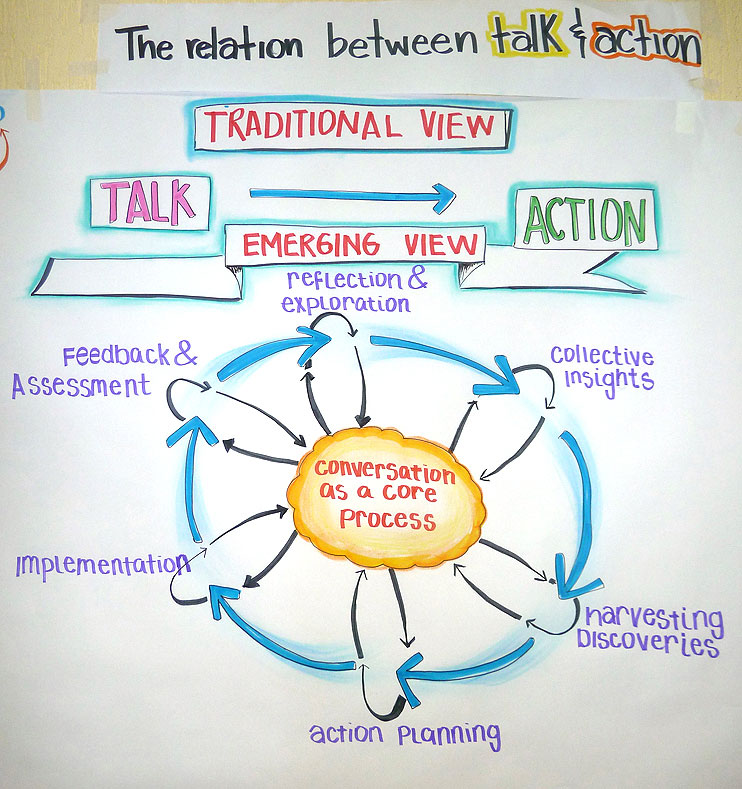
Conversation is not merely what happens before action. When people learn how to listen to and learn from one another, conversation becomes a way to develop collective insight, discover possibilities, and decide what to do together. Illustration: Art of Hosting.
Peter Block’s organization, Designed Learning, asks and answers a powerful question on its website: “How do you change the world? One room at a time. What room? The one you’re in.”
It’s such a simple idea, but it begs a very large question. If I can change the world starting in the room I’m in, what do I actually do? I’ve spent much of my working life in meetings—hundreds of them, probably thousands. And I’ve become convinced that changing what happens in those rooms can change what people become capable of doing together.
Over the past fifty years, a fundamentally different way of meeting and learning together has emerged. Rooted in the postwar experiments with group dynamics, human development, organizational learning, and participatory education, it begins with a different understanding of what can happen when human beings come together. People sit in circles instead of rows. They talk with one another instead of being talked to. They ask questions they don’t already know the answers to. They listen for what they can learn from one another. And the person who convened the meeting doesn’t necessarily know where the conversation will end.
Those early experiments have bloomed into a worldwide movement of practitioners developing new ways for groups to listen, learn, make sense, imagine, and act together. The practices go under a bewildering number of names: World Café, Open Space Technology, Circle, Appreciative Inquiry, ProAction Café, Liberating Structures, and many others. They come from different traditions and operate differently, but they share a powerful premise: we can design the way we come together to make more of our collective human capacity available.
I think of them collectively as social technologies. Just as other technologies are designed to extend what human beings can do, these are deliberately designed ways of helping groups make better use of our human capacities to listen, learn, make sense, imagine, and act together.
They aren’t all the same, and they didn’t originate in one place. World Café allows ideas to travel through a larger group by moving people among small conversations. Open Space lets participants determine what needs to be discussed and organize themselves around the questions they care about. Circle changes who speaks, how people listen, and where authority resides. Appreciative Inquiry begins with existing strengths and possibilities rather than deficiencies. Liberating Structures offers dozens of ways to distribute participation rather than allowing a few people to dominate a conversation.
What connects them is not a particular format. It is a different set of assumptions about people. Knowledge is distributed. Everyone may have something to contribute. No one person necessarily sees the whole. New understanding can emerge through interaction. And a group can sometimes discover possibilities that none of its members brought into the room.
This is what makes these practices so interesting to me. They aren’t meeting tricks. They suggest that our capacity to think and act together can be developed. We can learn to ask better questions. We can learn to listen differently. We can create conditions that allow more of what people know to become available to everyone. We can make emerging patterns visible. And we can create stronger connections between conversation and action.
I am barely skimming the surface. There is an enormous body of practice, research, experimentation, and hard-won experience behind these approaches, and I have a great deal to learn. But if radical hope asks us to look for plausible paths between the world we inhabit and the world we can imagine, I think this is clearly one of them. I intend to keep following it, and I’ll keep sharing what I learn.
FOLLOW THE THREAD
Start here: The Art of Hosting. This worldwide community of practitioners brings together Circle, World Café, Open Space Technology, Appreciative Inquiry, ProAction Café, and other approaches for helping groups have meaningful conversations that lead to learning, commitment, and action. It is a particularly good doorway into the larger world of social technologies because it treats them not simply as facilitation techniques, but as a practice for helping people work well together.
Then explore one of the practices: The World Café. Developed over the past three decades, World Café uses small groups gathered around questions that matter. As people move among tables, ideas travel with them, allowing patterns and insights to emerge across a much larger group. Its underlying proposition is directly relevant to my interest here: collective intelligence can emerge as people and ideas become connected.
Go deeper: Liberating Structures. Keith McCandless and Henri Lipmanowicz developed a growing collection of simple structures designed to replace or supplement familiar meeting forms such as presentations, managed discussions, brainstorms, and open discussion. The site now documents more than 40 structures that groups can use to include more voices, distribute participation, and draw on knowledge that conventional meetings often leave untouched.