September 18, 2026
Civics
The opposite of helplessness may be connection.
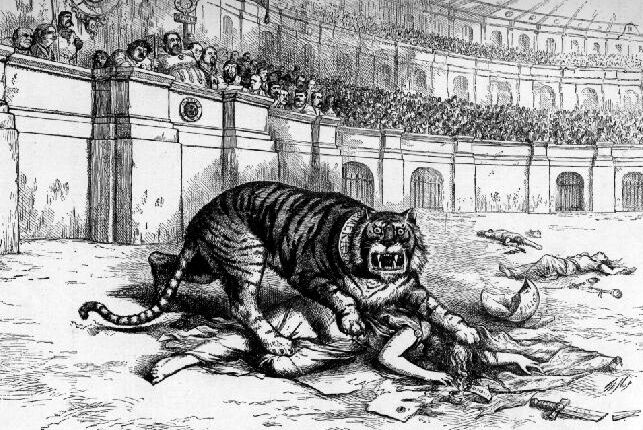
In 1871, cartoonist Thomas Nast depicted New York’s notoriously corrupt Tammany Hall political machine as a tiger mauling the Republic while Boss Tweed looked on. The image captured the danger Beccia describes: when corruption becomes powerful enough, it doesn’t simply enrich the corrupt. It begins to destroy faith in the rules everyone else is being asked to follow. Public Domain
My longtime friend, client, and idea collaborator, Jamie Wolf, sent me an article with a title that was pretty much impossible to ignore: Carlyn Beccia’s “Has America Crossed the Asshole Threshold?”
Beccia, who writes a great letter that she calls The Grim Historian, starts with a disturbing observation. Societies can tolerate a certain amount of corruption, greed, and self-dealing, but there is a tipping point. Once enough people discover that gaming the system works, everyone playing by the rules starts to feel like a sucker. Some eventually decide they might as well start gaming the system too.
Beccia calls this the asshole threshold. To explain the dynamic she ranges from ancient Rome and Tammany Hall to game theory. The part that caught my attention comes from political scientist Robert Axelrod’s famous experiments with the Prisoner’s Dilemma. Cooperation can be remarkably successful, but it depends on the conditions. Cooperators scattered among people who exploit them don’t fare very well. Cooperation becomes more resilient when cooperators can find one another, interact repeatedly, and build relationships in which cooperation is reciprocated.
This is a very important idea, so I’m going to say it again in different words: When people who want to cooperate find one another, keep showing up, and experience others doing the same, cooperation begins to reinforce itself. Each successful experience gives them more reason to cooperate again.
That history leads Beccia to the Gilded Age, another period of staggering inequality, political corruption, social distrust, and concentrated economic power. The movement away from those conditions—and society did, in fact, move beyond them—began, in part, when ordinary people found one another, organized, and built institutions capable of challenging them.
Between roughly 1870 and 1920, Americans formed unions, granges, women’s clubs, settlement houses, mutual-aid societies, congregations, PTAs, and thousands of other civic organizations. Those networks eventually developed enough power to change institutions and laws.
Beccia puts it memorably: “They found the people who could not be bought.” I find that idea enormously encouraging. The opposite of corruption isn’t simply honesty. And the opposite of helplessness isn’t necessarily individual courage. It may be connection.
When people find one another, work together, and experience cooperation producing results, they acquire evidence that being a sucker isn’t the only alternative to being an asshole. They discover another possibility: we can become more powerful by cooperating.
Which brings me back to a question I return to again and again: What conditions help human beings realize more of our capacity to cooperate? Community isn’t merely something pleasant to have around us. It may be one of the places where we learn—and relearn—that cooperation works.
ARTICLE: Has America Crossed the Asshole Threshold?