September 11, 2026
Learning
Maybe the smartest thing about us isn’t inside our heads.
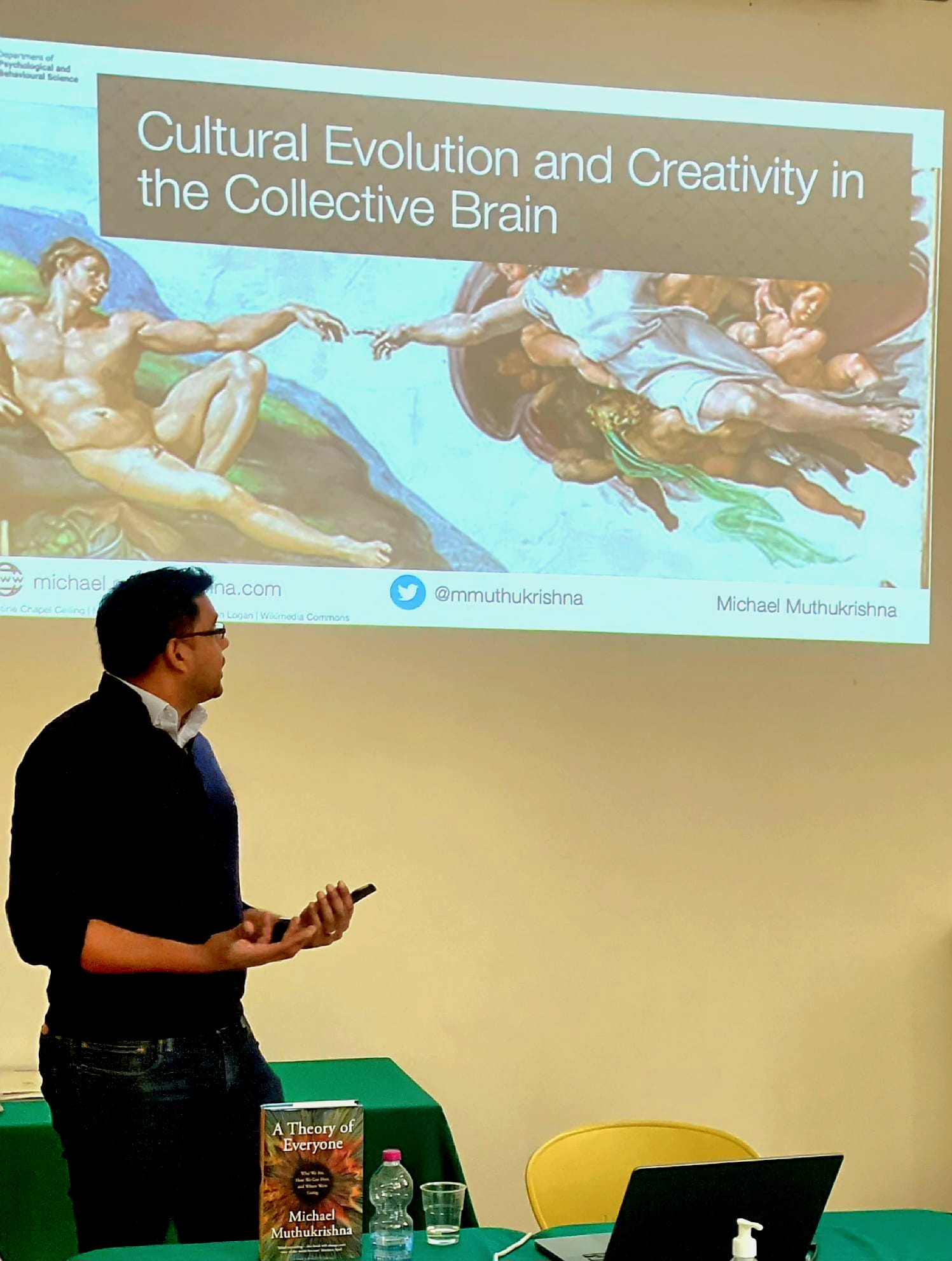
Michael Muthukrishna presenting his research on “Cultural Evolution and Creativity in the Collective Brain”, including his book, A Theory of Everyone, at Pontifical University of the Holy Cross, Rome, Vatican. Image via michael.muthukrishna.com
My return to Joseph Henrich sent me toward the work of Michael Muthukrishna, a cultural-evolution researcher who has been exploring an intriguing idea: What if some of humanity’s intelligence exists not inside individual brains, but in the connections among them?
Muthukrishna has explored this question in collaboration with Henrich. Working ogether, they call the idea the collective brain. We tend to tell the history of innovation as a story of unusually gifted individuals having unusually brilliant ideas. Their research suggests something different. Ideas move among us. Someone discovers something. Someone else copies it, improves it, or combines it with something learned somewhere else. Useful knowledge survives and circulates.
In a 2016 paper, Muthukrishna and Henrich propose that societies and social networks can function like collective brains. Over time, these networks can produce technologies, practices, and ideas that no single person could have invented—or even fully understood—alone.
This changes the question from How smart are the people? to How well are they connected?
The research suggests that the innovative capacity of a group depends in part on its sociality, the fidelity with which knowledge can be transmitted, and the variety of knowledge available to be recombined. More people do not automatically produce more intelligence. What matters is whether people can learn from one another and whether useful knowledge can move through the network.
Researchers have continued pushing the idea further. Work on the “cultural brain” explores the possibility that our individual brains and our social worlds evolved together: increasingly sophisticated culture created advantages for brains capable of acquiring and managing more cultural information, which in turn helped make more sophisticated culture possible.
I find the implications enormous. If some portion of human intelligence exists between us rather than simply within us, then the conditions connecting people matter enormously. Who gets to participate matters. Who has access to knowledge matters. Diversity matters. Teaching matters. Communication matters. Institutions matter.
And isolation has a cost beyond loneliness. When people, communities, disciplines, or generations stop learning from one another, we diminish the intelligence available to all of us.
Maybe becoming a more capable species isn’t simply a matter of becoming smarter individuals. Maybe it is also a matter of building better connections between us.
FOLLOW THE THREAD
Start here: Michael Muthukrishna’s A Theory of Everyone: The New Science of Who We Are, How We Got Here, and Where We’re Going. Muthukrishna takes the research on cultural evolution and collective intelligence and turns it into an ambitious, readable account of how human beings became capable of accumulating knowledge, cooperating at scale, and creating increasingly complex societies.
Then go to the research: Michael Muthukrishna and Joseph Henrich’s 2016 paper, Innovation in the Collective Brain. This is where they develop the idea that innovation depends not simply on brilliant individuals but on the size, connectivity, and knowledge-transmission capacity of the social networks in which they participate.
Go deeper: The Cultural Brain Hypothesis, by Muthukrishna, Doebeli, Chudek, and Henrich, explores the feedback loop between our increasingly complex cultural worlds and the brains capable of learning from them.