September 11, 2026
Learning
We can learn how to govern ourselves.
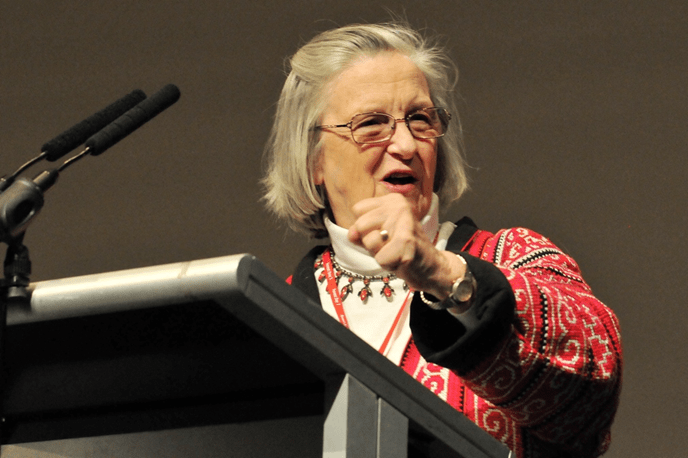
Elinor Ostrom showed that communities can learn to govern shared resources together—and that markets and governments are not our only choices. Image via Ostrom Workshop
For a long time, economists had a fairly discouraging answer to what happens when people share a limited resource. Imagine a pasture where everyone can graze cattle, a forest where everyone can cut wood, or a fishery where everyone can catch fish. Each person has an incentive to take as much as possible. Eventually the pasture is destroyed, the forest disappears, or the fishery collapses. Garrett Hardin famously called this “the tragedy of the commons.”
The usual conclusion was that there were two ways out. Privatize the resource and let the market govern it, or put the government in charge. Elinor Ostrom went looking at what people actually do.
She studied forests, fisheries, irrigation systems, pastures, and groundwater basins around the world. And she found communities that had managed shared resources successfully for decades and, in some cases, centuries. The people who depended on these resources had developed their own rules about who could use them, how much they could take, how behavior would be monitored, how disputes would be resolved, and what would happen when someone broke the rules.
Ostrom wasn’t claiming that people naturally cooperate. Commons fail all the time. People cheat. They take too much. They mistrust one another. Some accumulate power at the expense of others.
What interested her was why some communities learned to overcome those problems while others did not. When she compared durable systems with failed ones, patterns emerged. Successful communities tended to have clear boundaries. Rules reflected local conditions. The people affected by the rules could participate in changing them. People monitored what was happening. Sanctions started small and increased when violations continued. There were accessible ways to resolve conflicts. And the community’s right to organize itself was recognized rather than overridden by outside authorities.
These weren’t commandments Ostrom believed everyone should follow. She was careful about that. She had studied too many different communities to believe there was one institutional recipe. They were patterns she discovered by observing arrangements that had endured.
That distinction matters. Ostrom wasn’t offering a utopian theory about how cooperative human beings are. She was documenting something more useful: people can learn how to cooperate, and they can turn what they learn into institutions.
Rules can be invented. They can be tested, and they can be changed. Most importantly trust can grow through repeated experience. Communities can learn which arrangements work under their particular conditions and modify them when they don’t.
In 2009, Ostrom became the first woman to receive the Nobel economics prize. The award recognized her work demonstrating that the choice is not simply between markets and states. Human beings have created many other ways of organizing ourselves, including systems in which the people who depend upon a shared resource participate in governing it themselves.
That strikes me as a profoundly hopeful finding. We don’t have to assume that the institutions we inherited exhaust the ways human beings can organize themselves. We can learn how to make new ones.