September 11, 2026
Learning
We know how to make a “we.”
Michael Tomasello has spent much of his career trying to understand something so ordinary that we rarely stop to think about it: how human beings manage to do things together.
Tomasello is a developmental and comparative psychologist who has studied young children alongside our closest primate relatives. Other animals cooperate, but human beings appear to possess something more unusual: the ability to understand that we are doing something together. He calls this shared intentionality. We can establish a common goal, recognize our different roles in achieving it, focus our attention together, communicate about what we are doing, and adjust our behavior to help one another succeed.
Even very young children do this. In experiments where an adult suddenly stops participating in the middle of a collaborative activity, children will often try to reengage the adult. They aren’t simply trying to finish the task. They seem to understand that this was something we were doing.
That little word carries an astonishing amount of human civilization inside it. A “we” makes it possible to hunt together, raise children together, teach one another, build a house, play in an orchestra, conduct a scientific experiment, restore a wetland, run a library, form a government, or send a spacecraft to another planet. None of these depends simply on putting enough intelligent individuals in the same place. They require people who can establish shared purposes, understand different roles, communicate what they know, and coordinate their actions.
Tomasello’s work does not suggest that human beings are invariably cooperative. Obviously we aren’t. Cooperation can be encouraged or suppressed. Groups can cooperate for destructive purposes as easily as constructive ones. Our remarkable capacity to form a “we” does not tell us what the “we” will choose to do.
But it does tell us something important about what we are capable of. Henrich shows us that human knowledge can accumulate because we learn from one another. Tomasello takes us one step further. We aren’t merely a collection of individuals exchanging information. We possess the capacity to create shared intentions, shared knowledge, shared norms, and eventually shared institutions.
We can think and act together. That capacity may be one of the most important things we have to work with.
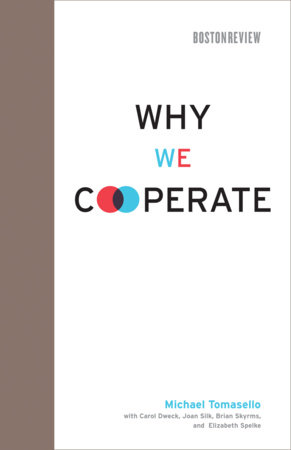
BOOK: Why We Cooperate