September 11, 2026
Learning
We are not done becoming.
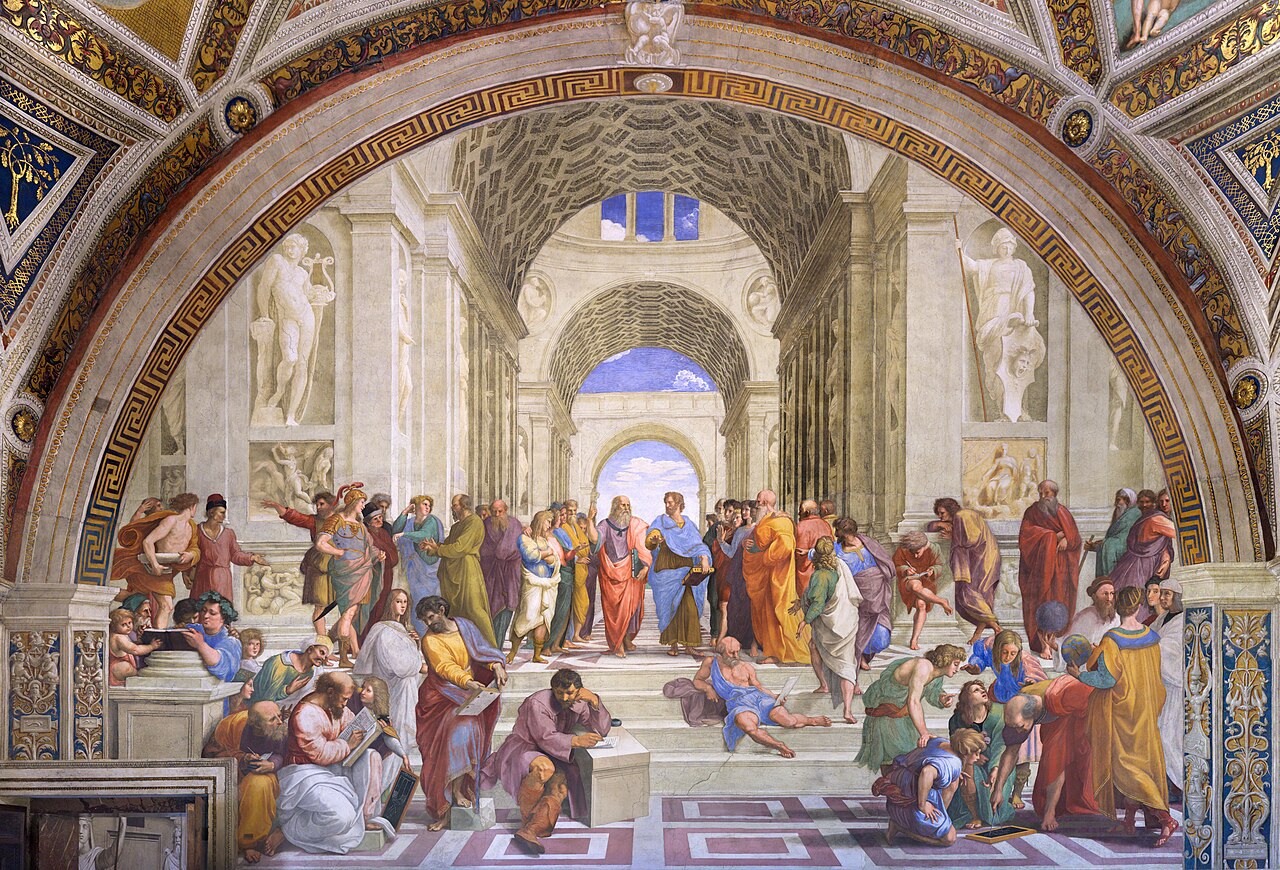
Raphael, The School of Athens, 1509–1511, Vatican Palace, Rome. Raphael imagined human knowledge not as the possession of a single great mind, but as a conversation extending across generations.
I started Love & Work because of a belief I have carried with me for most of my life: human beings have enormous unrealized potential.
We are biological creatures with the remarkable capacity to think, imagine, communicate, cooperate, make things, and learn from one another. Even more remarkably, we can pass what we learn to people we will never meet and generations not yet born. That seems to me to carry a responsibility. If we possess these capacities, then surely part of being human is learning how to use them well.
For a brief and exhilarating moment in the late 1960s and early 1970s, it seemed as though much of the culture was testing those capacities. What else could we learn about ourselves? How differently might we live? Assumptions about race, gender, war, work, sexuality, the environment, authority, and even consciousness itself were suddenly up for grabs.
One of the most consequential questions was how human beings actually develop. Researchers were paying closer attention to how children learn. Educators were questioning the distinction between learning and schooling. Psychologists were asking what conditions allow human capacities to emerge. Around me, people were experimenting with different ways of teaching, working, living, and learning together.
I absorbed a powerful idea from all of this. Curiosity, intelligence, imagination, and the desire to learn aren’t capacities that need to be installed in us. They are already there, ready to develop when given the conditions that allow them to flourish. That possibility has stayed with me ever since.
But our capacity to learn does not guarantee progress. Gloria Steinem had a useful name for part of what happens. She called it “frontlash.” Significant change creates backlash precisely because something has changed. People and institutions whose wealth, authority, status, and sense of control are threatened push back. Gains can be slowed, compromised, and sometimes reversed. But the resistance itself can be evidence that the starting point has moved.
And yet, when we pull the camera back far enough, something important becomes visible. Across many measures of human well-being and freedom, the gains have ultimately been greater than the take-backs.
That does not mean the work is finished. Slavery still exists, but much of humanity has learned to regard it as morally indefensible. Women have gained rights that remain denied or threatened in many places. We learned how to prevent diseases that once routinely killed children, even as some of that hard-won knowledge is being challenged today. We have brought polluted rivers back to life while continuing to damage the living world on an enormous scale.
Progress is neither complete nor secure. What we learn can be resisted, forgotten, distorted, or deliberately undone. But over generations, knowledge can accumulate. Expectations can change. Gains that were once radical can become ordinary, providing the starting point for the next round of learning.
We are a learning species. That matters enormously right now. We have created technologies powerful enough to threaten our future. We have also created tools capable of expanding access to knowledge, intelligence, and one another on a scale no previous generation could have imagined.
There is nothing inevitable about what happens next. Our opportunity is to keep learning, to share what we learn, and to help others discover that they can learn and contribute, too.
That is why I keep gathering the stories in Love & Work. They are evidence of people learning how to do things differently, and then making what they learn available to the rest of us. My hope is that seeing what others have learned expands our own sense of what is possible—and inspires us to try something, too.
Hope doesn’t require believing that progress is inevitable. But it does require that we recognize that learning is possible, that learning accumulates, and that we can participate in what humanity learns next.
No items found.