August 21, 2026
Teaching
Start with questions, not answers.
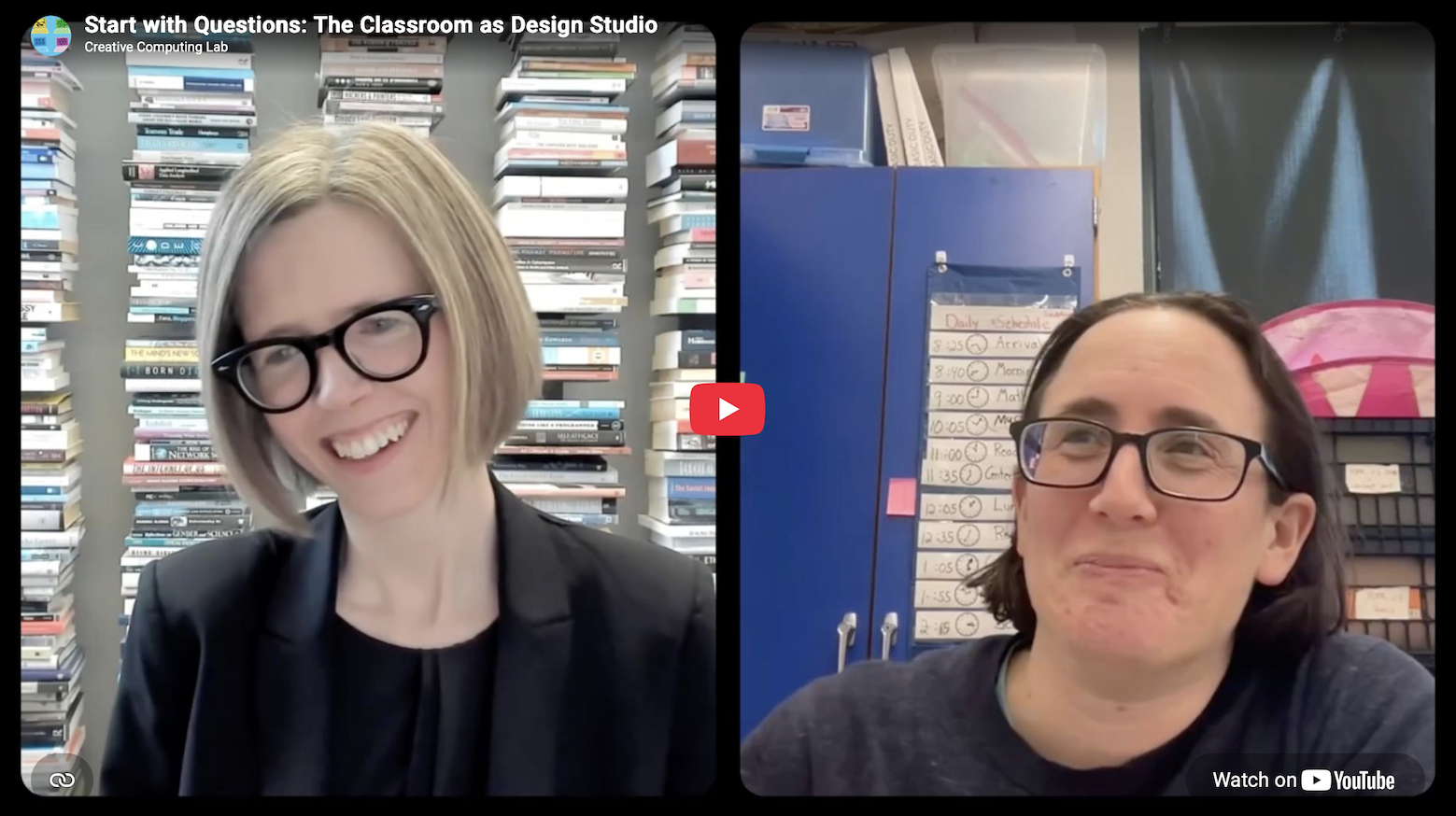
Karen Brennan and Sarah Blum-Smith. Image from video Start with Questions: The Classroom as Design Studio
Karen Brennan and Sarah Blum-Smith came to teaching from different directions.
Brennan came through computer science. As a doctoral student at the MIT Media Lab, she worked with Mitchel Resnick and the team developing Scratch, the programming language designed to help young people learn by making things they actually care about. It introduced her to a tradition of thinking about education that goes back to Seymour Papert: people don’t simply acquire knowledge. They construct it through exploration, experimentation, and making.
Blum-Smith came through the classroom. She studied education at Harvard, where Brennan became one of her teachers and eventually chaired her doctoral dissertation. Then, after earning her doctorate, Blum-Smith did something relatively unusual. She became an elementary-school teacher in the public schools in Medford, Massachusetts.
Their collaboration brought together two perspectives: a researcher who had spent years studying creative, learner-centered education and a teacher confronting the practical realities of making it work with actual children in an actual classroom.
And they shared a problem. Both believed deeply in giving students more control over their own learning. But they also believed deeply in teachers.
So what is the teacher’s job when the student is directing the learning? Instead of answering that question in theory, Brennan and Blum-Smith went looking for teachers who were already figuring it out.
For a year, they studied 25 elementary, middle, and high-school teachers who gave students meaningful freedom to decide what they wanted to make, explore, and learn. They interviewed them, observed their classrooms, and studied their reflections on what was happening.
What emerged became Start with Questions: The Classroom as Design Studio. The teachers they encountered weren’t standing aside and leaving students to figure everything out for themselves. They were intensely involved.
But they were doing something different. They were asking questions. What are you interested in? What’s your vision? What did you try? What are you trying to do? What do you think? These weren’t questions with answers sitting in the teacher’s head. Brennan calls them genuine questions. The teacher actually wants to know.
That small distinction changes the relationship. Instead of beginning with Here is what I need to teach you, the teacher begins with What are you trying to understand or accomplish, and how can I help?
Brennan and Blum-Smith describe this as the classroom becoming a kind of design studio. Students have ideas they want to bring into the world. Teachers provide tools, expertise, encouragement, critique, structure, and challenge.
The teacher doesn’t disappear. If anything, the work becomes more demanding. You have to pay attention to the particular person in front of you rather than simply deliver the next lesson.
And perhaps that is the most interesting insight in Start with Questions. The questions a teacher asks reveal something about who they believe owns the learning.
Ask a student to give you the right answer and the learning still belongs largely to you. Ask them what they’re trying to do, and suddenly it belongs to them.
BOOK: Start with Questions: The Classroom as Design Studio
WEBSITE: Start with Questions