August 7, 2026
Communication
The power of a better question
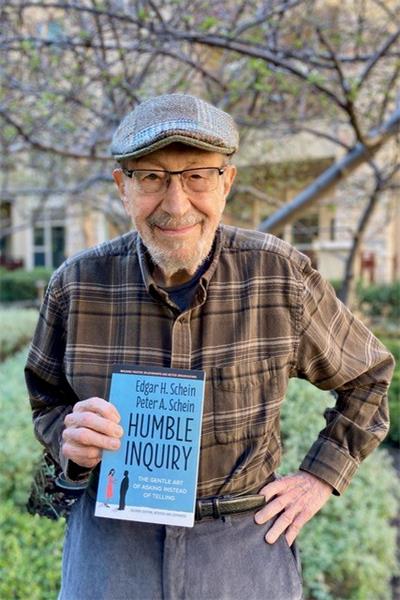
Image via Matt Minahan
The person asking the questions often learns more than the person giving the answers. Edgar Schein built an entire philosophy of leadership around that deceptively simple idea.
When Schein joined the MIT Sloan School of Management in 1956, organizational culture wasn’t yet a field of study. Over the next six decades, he helped create one.
Today almost everyone uses the phrase organizational culture, but it was Schein who gave the idea intellectual rigor. He showed that every organization operates on three levels: visible artifacts, stated values, and deeply held assumptions. His enduring insight was that those hidden assumptions—not the mission statement on the wall—shape how people actually behave.
As his work evolved, so did his understanding of leadership. Unlike many consultants, Schein became convinced that leaders and advisors should stop arriving with answers. Their job was not to be the smartest person in the room. It was to help the room become smarter.
He called this approach process consultation. Instead of solving problems for organizations, consultants helped organizations discover their own solutions.
Late in his career, Schein made one more important discovery. Even experienced consultants—and especially leaders—often undermine the very relationships they hope to strengthen. Why? Because they tell instead of ask. They diagnose before they understand. They offer advice before they’ve earned trust.
That realization led to Humble Inquiry, a book that distills a lifetime of research and consulting into one deceptively simple practice: Ask questions to which you genuinely do not know the answer.
For Schein, this wasn’t merely a communication technique. It was a different way of relating to other people. Genuine curiosity lowers defenses, builds trust, and creates the conditions where people are willing to share what they actually know rather than what they think they’re supposed to say.
In a world that rewards expertise and quick answers, Humble Inquiry reminds us that the best leaders are not always the ones with the strongest opinions. More often, they are the ones who know how to create conversations where other people’s best thinking can emerge.
BOOK: Humble Inquiry, The Gentle Art of Asking Instead of Telling