August 7, 2026
Communication
Learning to think together
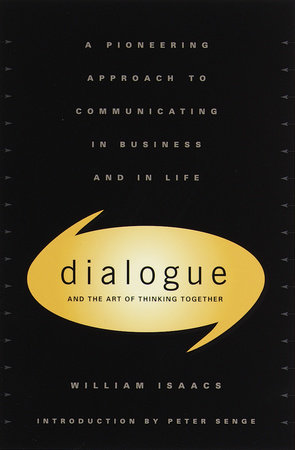
William Isaacs asks a question that opens all kinds of doors: What becomes possible when a group learns to think together?
His answer stretches our understanding of communication itself. Dialogue, he suggests, is far more than conversation. It is the practice of creating the conditions where a group can discover insights that none of its members could have reached alone.
We’ve all experienced the paradox: a room full of bright, thoughtful people somehow arrives at shallow conclusions. Isaacs explains why. The quality of a group’s thinking depends less on the intelligence of its members than on the quality of attention they bring to one another.
That insight leads to one of the book’s most important distinctions. Dialogue isn’t discussion. The word discussion shares its roots with percussion and concussion. Ideas are struck against one another. We compare, critique, defend, persuade, and decide.
Dialogue has a different purpose. It isn’t about winning an argument or reaching a decision. It’s about creating the conditions where new understanding can emerge—understanding that no individual could have produced alone. Its goal is not to win an argument but to enlarge understanding.
Isaacs draws on the work of physicist David Bohm, who believed thought itself is largely collective. None of us arrives at our beliefs alone. Language, assumptions, metaphors, habits, and culture all shape what we perceive before we ever open our mouths. Dialogue invites us to make those hidden assumptions visible. Not so they can be defeated, but so they can be examined together.
This is difficult work. It requires listening without immediately preparing a rebuttal. It asks us to suspend certainty long enough for something genuinely new to emerge. The reward is not consensus. It is collective intelligence.
For organizations, communities, and democracies alike, that may be one of the most valuable capacities we can cultivate. We often celebrate charismatic leaders and persuasive speakers. Isaacs reminds us that our future may depend just as much on people who know how to create conversations where everyone becomes wiser than they could have been alone.
BOOK: Dialogue and the Art of Thinking Together
ARTICLE: The Art of Dialogue