July 3, 2026
Civics
America Unfinished: A plain-sight inventory of the state of the nation
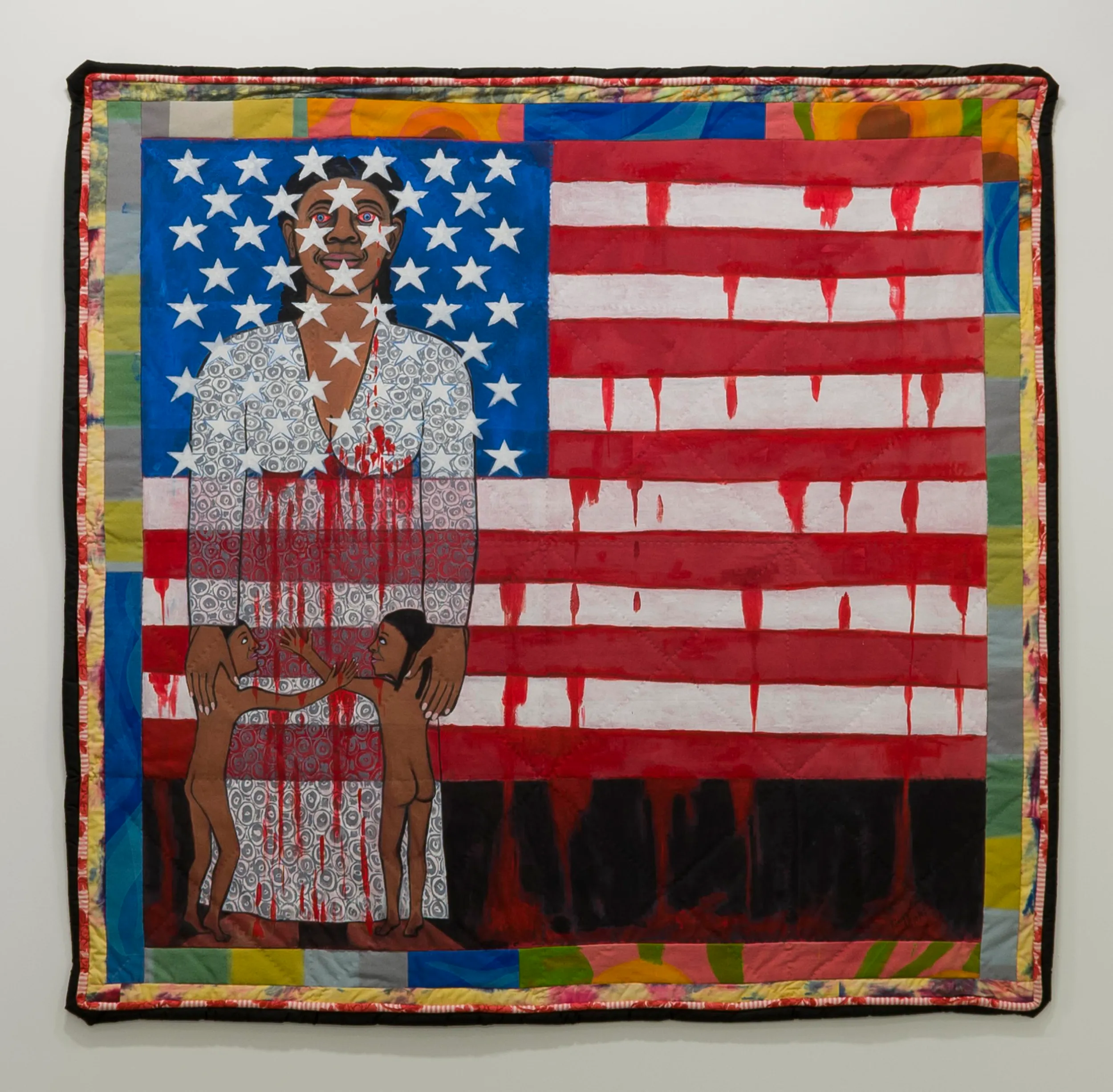
The American Collection #6: The Flag is Bleeding #2, Faith Ringgold, 1997
This letter is being posted on July 3, 2026, the day before America’s 250th anniversary. Like many people, I’m not feeling particularly celebratory. The fireworks, the flags, the fighter jets, the politicians blessing the republic, the sponsors blessing an innacurate myth, the logos blessing the sponsors—the whole noisy American pageant arrives at a moment when many of us feel more weary than triumphant, more anxious than proud.
And yet this is precisely the kind of moment that calls for radical honesty rather than easy consolation. If we hope to shape a livable future, we first have to look unflinchingly at the world as it is—ecologically, politically, economically, and spiritually. Radical hope is not optimism. It is the discipline of refusing to look away, trusting that only by seeing clearly can we begin to imagine something truer and more life-giving.
In that spirit, this edition of Love & Work is neither a celebration nor a lament. It is an honest reckoning, written in the still-lengthening shadow of 250 years of extraordinary promises, many of which remain unfulfilled.
Rather than a collection of individual articles, this week I invite you on a single walk through the state of the nation as seen through the lenses we’ve been cultivating together: nature and habitat, culture and communication, civics and economics, company and work, teaching and learning, justice and care.
This isn’t tidy. It certainly isn’t pretty. Systems in transition never are. My hope in gathering these observations into one place is that they leave us feeling more oriented—less alone in our misgivings and more accompanied in our determination to meet this moment with clear eyes and an open heart.
If this is where we truly stand at 250, what kinds of futures are still possible? And what forms of love and work will they ask of us? This is an invitation to see our time as it truly is: not as a series of disconnected crises, but as the predictable outcome of a culture that forgot it was embedded in Earth, in history, and in each other.
Happy Friday. I do hope you can find some reasons to celebrate this weekend. Because radical hope begins by refusing to let fear become the only thing we notice.
We are not imagining the fractures we see.
Eleven angles on the same cracked mirror, each shard reflecting back the one question we keep dodging: what have we really built here?
1. Nature and Earth Systems
Nature and Earth systems, circa 2026, are in a state of acute strain and slow response: global temperatures are locked “at or near” record levels, biodiversity loss continues to accelerate under growth‑first economic models, and the basic life‑support functions of air, water, soil, and climate are being compromised faster than our governance systems are able—or willing—to respond.
2. Bodies, Care, and Health
Bodies and care systems in America are telling a story of simultaneous abundance and neglect: we have extraordinary biomedical tools and record health spending, yet basic care remains fragmented and unequal, reproductive rights are contested or curtailed, mental‑health and addiction crises run ahead of our capacity to respond, and the daily work of tending to children, elders, and the sick still falls largely on undervalued, underpaid, and often invisible caregivers.
3. Culture, Story, and Meaning
Our shared cultural imagination is caught between collapse and possibility: old narratives of progress, exceptionalism, and “back to normal” no longer fit the world as it is, yet we have not yet grown a widely shared set of stories about how to live well within limits, across difference, and in kinship with more‑than‑human life—leaving many people oscillating between apocalyptic doomscrolling and thin optimism, with little guidance in the deeper arts of meaning‑making, ritual, and repair.
4. Democracy, Law, and Power
Democracy, law, and power in the United States appear both continuous and profoundly distorted: elections still occur, courts still convene, and constitutional language is still invoked, but voting rights and civil-rights protections are steadily constricted, executive and corporate power have expanded, and whole communities encounter the rule of law as delayed, uneven, or absent—exposing the nation’s enduring contradictions and raising urgent questions about who this system truly serves at 250 years and how much legitimacy it can claim.
5. Economy, Work, and Class
The macro‑economy looks deceptively healthy—steady growth, low unemployment on paper, strong corporate profits—while life for many workers and communities feels precarious and brittle: the gains of growth flow disproportionately to asset‑holders and highly credentialed workers, the middle class is squeezed by housing, healthcare, and debt, lower‑income households contend with chronic insecurity, and whole regions find themselves left behind, even as new wealth pools around AI, green tech, and financialized markets.
6. Habitat, Infrastructure, and Commons
Our habitats and civic infrastructures reveal a country that under‑maintains what it has and hesitates to build what it needs: housing is scarce or unaffordable in many places, public spaces and civic buildings are carrying more social and emotional load than their budgets can bear, aging pipes and grids strain under new extremes, and genuinely regenerative projects—low‑carbon neighborhoods, living buildings, resilient public spaces—remain the exception rather than the norm in most people’s daily lives.
7. Teaching, Learning, and Imagination
Teaching and learning, from K–12 through higher education and beyond, are in a prolonged moment of strain and improvisation: schools and colleges are spending more than ever, yet achievement gaps and trust gaps persist, educators are asked to remediate pandemic losses and navigate culture wars simultaneously, and the informal curriculum of platforms and algorithms is shaping our attention, our values, and our capacity to imagine the future far more powerfully than anything we intentionally teach in schools.
8. Identity, Relationship, and Belonging
The landscape of identity, relationship, and belonging is both more expansive and more contested than at any earlier point in the republic’s history: legal recognition and cultural visibility have grown for many marginalized groups—across race, gender, sexuality, disability, and belief—yet backlash, polarization, and structural inequities continue to mark whose lives are grievable, whose families are recognized, and who feels they have a durable place inside the ever‑fragile “we” called America.
9. Race, History, and the American Myth
Race remains a central, often disavowed, organizing force in American life: even as the nation tells stories of progress, diversity, and inclusion, the deeper architecture of racial hierarchy continues to shape access to safety, wealth, mobility, and voice, reinforced through policy, practice, and cultural narrative. Moments of reckoning are repeatedly followed by erasure or backlash, as the country struggles to face the truth that its democratic ideals have always been entangled with racial exclusion—leaving us caught between what we say we are and what we have been unwilling to repair.
10. Memory, Ritual, and the 250th Itself
Our practices of memory and ritual are deeply divided: as the 250th approaches, official commemorations tend to emphasize continuity, heroism, and national achievement, while counter‑rituals and critical histories insist on remembering enslavement, dispossession, exclusion, and unfinished struggles, leaving us with overlapping—and often incompatible—stories about what exactly we are commemorating and what, if anything, it would mean to mark this anniversary truthfully.
11. Faith in the Future and Radical Hope
Faith in the future is fragile: surveys show declining confidence that the next generation will be better off, especially among those already facing economic and political marginalization, even as many younger people still express a strong belief in their own capacity to create change; in this gap between personal agency and systemic pessimism, radical hope asks us not to manufacture optimism, but to face the depth of our entanglements and losses while still choosing to invest in futures we cannot yet fully imagine.
The 250th anniversary is not a verdict. It’s a checkpoint.
The story of this land is still being written. Our love, our grief, and our willingness to act can help bend it toward a more life-giving future.
By the time we reach the end of a list like this, it’s tempting to go numb. Eleven domains, each with its own crises and contradictions. A country that can feel, depending on the day, both overdiagnosed and undertreated.
Part of me hesitated to lay it out this starkly. Our culture already saturates us with bad news. Why add another layer?
But if Love & Work has a central theme, it’s this: the problem isn’t that we care too much. It’s that we’ve rarely been given a coherent picture of what we’re caring about.
Instead, we’re handed fragments—climate headlines here, court decisions there, a viral video about police violence, a think piece about AI, a story about a failing school or a closing hospital—and left to make sense of them on our own. Our institutions divide reality into sectors. Our media divide it into posts. Meanwhile, our nervous systems keep telling us that all of it belongs to the same story.
What I’ve tried to offer here is not a definitive map—there is no such thing—but something closer to a wayfinding guide. Nature, economy, democracy, care, culture, habitat, and imagination are not separate subjects. They are different expressions of the same living system. Tug one strand and the others move. When a river is poisoned, a school is starved, a neighborhood is displaced, or a court is captured, we are not witnessing different stories. We are watching the same pattern appear in different forms.
“What we are doing to the forests of the world is but a mirror reflection of what we are doing to ourselves and to one another.”
— often attributed to Gandhi
The good news is that systems work both ways.
When relationships are repaired in one part of the fabric, the effects spread outward. Strengthen a commons and trust often grows alongside health. Shift an economy from extraction toward reciprocity and isolation begins to loosen. Change the way a classroom works and we’re not simply improving education; we’re rehearsing a different democracy.
The projects gathered throughout this catalog—land trusts and cooperatives, neighborhood libraries and living buildings, regenerative farms and mutual-aid networks, reimagined schools and new forms of civic life—may look small and local, but they rhyme. They are not isolated acts of goodness. Together they sketch another way of being human.
“America Unfinished” is one way of naming this moment.
The 250th anniversary is not a verdict. It’s a checkpoint. A chance to acknowledge how far we’ve drifted from our stated ideals while recognizing how many people are already practicing alternatives in the cracks of the old order.
This status report is not meant to leave us with a catalogue of decline. It is meant to help us recognize the terrain we’re already walking.
Because Love & Work has always been written for people who sense that the world’s problems are connected—and that our own work, whether in a classroom, a neighborhood, a council meeting, a farm, a studio, a clinic, or a union hall, is connected as well.
“The great work now, is to carry out the transition from a period of human devastation of the earth to a period when humans would be present to the planet in a mutually beneficial manner.” – Thomas Berry
So here’s my invitation as we cross this anniversary together.
Let’s use this rough map not as a reason to retreat, but as a way to locate ourselves. Where do we already stand? Which parts of this landscape are already calling for our attention?
Let’s notice where the dreamer, the renegade, or the tender-hearted good kid in each of us wants to lean a little further—not to fix everything, nor to carry the nation on our shoulders, but to strengthen one strand of the larger weave.
Radical hope is not optimism with better branding. It is the decision to keep learning, grieving, imagining, and acting with open eyes. We are not imagining the fractures we see. Neither are we powerless to help mend them.
We came all this way to explore the future. The most important thing, as ever, is that we rediscover the Earth—and one another.
Image
The American Collection #6: The Flag is Bleeding #2 (1997) is a large acrylic-on-canvas painting with a pieced fabric border by Faith Ringgold, held in the Glenstone collection and exhibited at the de Young Museum.
The painting revisits Ringgold’s 1967 work, The American People Series #18: The Flag is Bleeding, which depicts an American flag dripping blood over three figures—an image of racial violence and fractured unity in the 1960s.
In the 1997 version, Ringgold again paints an American flag that appears to bleed, partially concealing a Black woman with two children clinging to her. The composition places Black family life both behind and within the national symbol.
The border is constructed like a quilt—combining painted and pieced fabric—linking the work to African American textile traditions and to Ringgold’s story quilts, while retaining the structure of a painting.
The American Collection series reimagines American art history from a Black feminist perspective, foregrounding Black women’s lives, family, and survival as central to the national narrative.
Photo by Rob Corder.