June 19, 2026
We are not limited to who we are today.
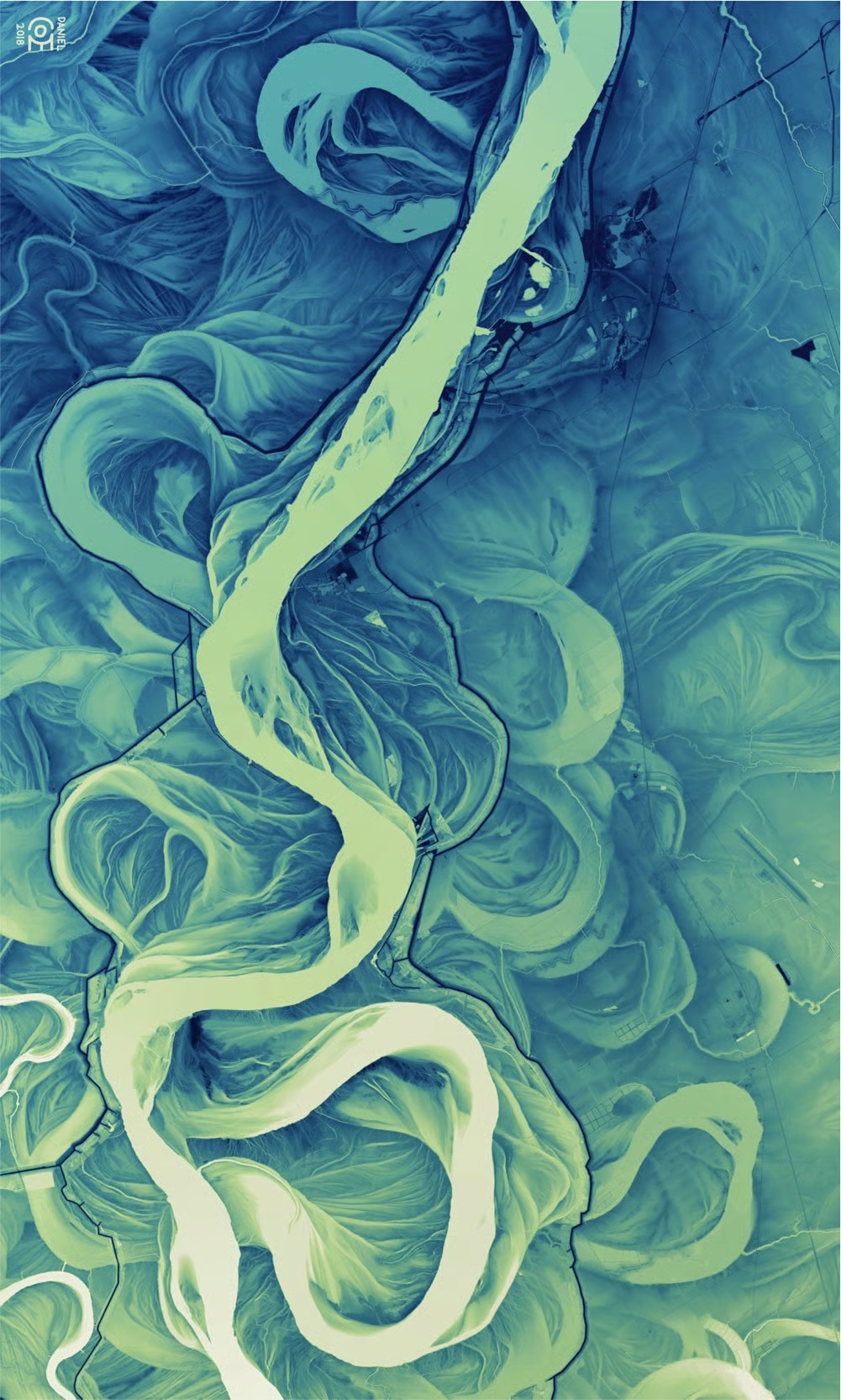
Mississippi River lidar greens
I grew up in the long gray shadow of the 1950s, when the ideal life was presented through black-and-white television as orderly, fixed, and already decided. There were scripts for how to dress, how to work, how to love, and how to belong. The feeling I remember was a bit like wearing a pair of stiff leather school shoes: respectable, constraining, and unbelievably uncomfortable.
Then, seemingly without warning, a new technicolor energy cracked that picture open. Suddenly a whole generation was encouraged to imagine new ways of being. It became possible to see that life was not a settled fact but an unfolding process. Culture can change. Consciousness can change. Roles can change. Institutions can change. They can because people can change.
The Jefferson Airplane’s declaration that “life is change” became a mantra for my generation. Everything changes. Nothing stays the same. In “Crown of Creation,” they hinted at something larger: that human beings possess extraordinary capacities for growth and change.
The hard news is that possibility and capacity are not the same thing. We can see injustice, ecological decline, loneliness, and polarization. We can care deeply about them. Yet there remains a gap between what we long for and what we know how to bring into being.
The question is not whether we care. It is whether we can develop the capacities needed to act on what we care about.
Today that question matters more than ever. Many people carry a conviction that they are too small and that it is too late to matter. Ecological imbalance, democratic decay, economic insecurity, cultural fragmentation, and technological acceleration can make ordinary life feel like a spectator sport, and we’re just watching events unfold from the cheap seats.
But that conclusion rests on a mistaken picture of both human beings and change. Much of our culture rests on an unspoken assumption: that who we are today largely determines who we will be tomorrow. If people are fixed, then society must be fixed too. Our habits appear permanent, our institutions inevitable, and the fear, competition, loneliness, and extraction around us begin to look like facts of life rather than conditions we have created.
Yet as Grace Slick sang, human beings are not built for stasis. As a species, we have survived by changing how we live, think, and cooperate far faster than our genes can change. We are biologically, psychologically, and culturally structured for learning, adaptation, and growth.
The person you are today is real, but unfinished. The society we are living in is real, but unfinished too.
This is one of the great hidden truths of social life: development is not an exception to the human story. It is the human story. Children become adults. Traditions evolve. New ideas spread. Communities learn. Every generation inherits a world it did not create and leaves behind a world it has helped reshape.
Nearly everything that makes modern life possible—from literacy and libraries to public health, democratic practices, and ecological restoration—emerged because people learned from one another and added something to a shared inheritance.
Seen in this light, the future is not something that happens to us. It is something we participate in.
That does not mean we can control everything. We cannot. Many things are clearly breaking down. Yet renewal is happening too. Across the world, people are experimenting with better ways to teach, govern, grow food, share power, restore ecosystems, strengthen communities, and organize work. They are demonstrating that other futures are possible.
If social progress advances through collective learning, then your task is not to do everything. Your task is to contribute something.
Human beings can grow, and we each have a role to play. These two realizations belong together. If growth is real, then the self is not a cage. We are not locked inside our current capacities, fears, or assumptions. And because growth is not only personal, developing ourselves is also one way we contribute to the larger worlds we inhabit.
To say that you are too small and too late is to misunderstand how human worlds are made. Most lasting change begins not at the center but in relationships—in examples that spread, practices that catch on, and people who decide that the current arrangement is neither natural nor final.
Life is change. The question is whether we will participate in it consciously. No one is asked to save everything. But everyone is invited to become a more useful participant in this unfinished story.
This reality is the basis of the radical hope I feel: that human beings are capable of far more than we often imagine.
About the artwork
Lidar-derived image of the Mississippi River along the Arkansas–Mississippi border, southwest of Memphis, Tennessee. Image by Daniel Coe.
Lidar uses laser pulses fired from aircraft to create highly detailed maps of the Earth’s surface. By removing trees, buildings, and other structures, it reveals the underlying topography with remarkable precision.
What emerges here is a portrait of the river’s geomorphic memory—a time-compressed record of where the Mississippi has flowed over centuries.
The present channel is surrounded by ghost channels, abandoned meanders, and oxbow lakes preserved as subtle ridges and depressions across the floodplain. The delicate, branching patterns trace natural levees, sediment deposits, and erosional features left behind as the river migrated across the landscape.
Straight lines cutting through the image reveal a more recent layer of history: levees, roads, and field boundaries imposed by human settlement on top of the river’s older forms.