June 19, 2026
Culture
Culture is human evolution's hidden engine.
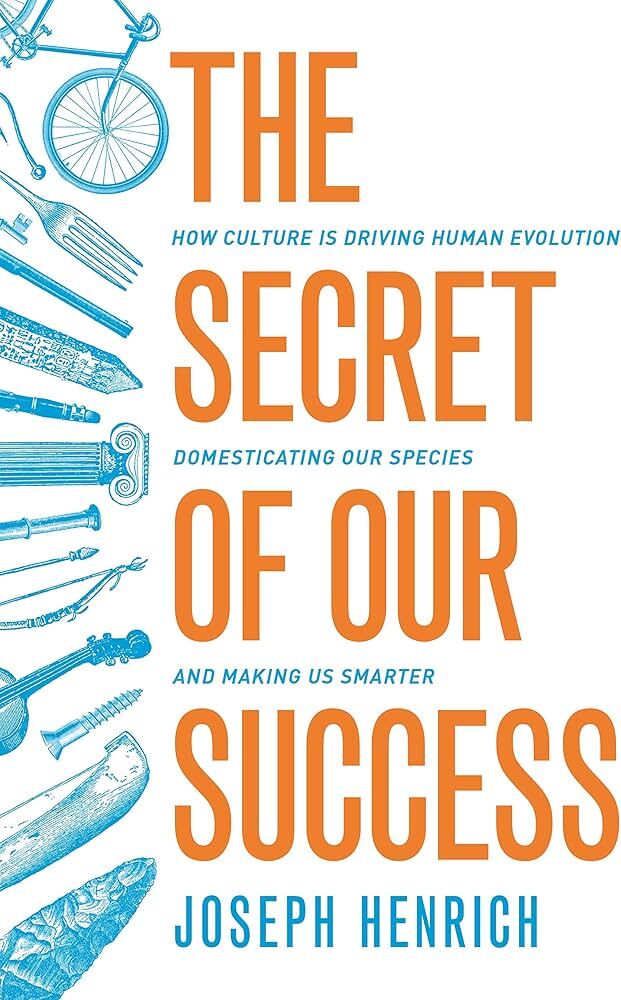
For a long time the dominant story of human exceptionalism was simple: we are smarter than other animals. Bigger brains, higher IQs, greater reasoning power. The Secret of Our Success: How Culture Is Driving Human Evolution, Domesticating Our Species, and Making Us Smarter offers a different explanation. Joseph Henrich argues that what truly sets humans apart is not individual brilliance but our capacity to learn from one another, accumulate cultural knowledge, and pass it forward across generations. In his telling, we are not the genius species; we are the cultural species.
The book’s central claim that human nature itself has been shaped by cumulative cultural evolution, and culture has become a driving force in human evolution in its own right. Henrich asks us to stop thinking of culture as something separate from human nature. Culture doesn’t just sit on top of who we are. It helps shape who we become.
New ideas, habits, and ways of living can spread through a society much faster than genes can change. Over time, those cultural changes reshape the environments we live in, the food we eat, the people we cooperate with, and the challenges we face. In turn, those new conditions influence which traits are rewarded and passed along.
The result is a long dance between culture and biology. Over hundreds of thousands of years, humans have been shaped not only by natural selection, but by the cultures we created. We became a species unusually skilled at cooperation, guided by shared norms, and deeply dependent on one another for survival.
Henrich points to a surprising fact. In some laboratory tests, other primates outperform humans. They can have better working memory, solve certain puzzles more quickly, and make smarter decisions in specific situations.
Yet humans are the ones who spread across the globe and learned to thrive almost everywhere.
The reason is not that any one of us is exceptionally smart. It’s that we learn from one another. A person dropped alone into the wilderness would struggle to survive. Most of us don’t know how to make a bow, build a kayak, grow enough food, or create modern medicine from scratch.
What makes our species remarkable is not individual intelligence but shared intelligence. We inherit knowledge from countless people who came before us, add a little of our own, and pass it along. Human progress comes less from lone geniuses than from our ability to learn together and build on what others have already discovered.
Seen in this light, cumulative cultural evolution appears everywhere once you know how to look. It is present in the small, iterative improvements in tools, food preparation, and clothing that allow groups to survive in harsh climates. It is present in the gradual refinement of social norms that enable large-scale cooperation, trust, and exchange. It is present in the rituals, stories, and teaching practices that carry values across generations. Over time, these collective brains function almost like superorganisms, systems whose problem-solving capacity depends on group size, diversity, and the density of social connections.
Henrich is equally clear about the preconditions. Collective brains are not automatic. They depend on particular forms of social learning: imitation, teaching, language, and attention to skilled models. They flourish when communities are large and interconnected enough to sustain variation and selection among ideas, but not so fragmented or unequal that knowledge stops circulating. Cultural evolution, in this sense, is not merely a metaphor. It has its own dynamics—innovation, copying, error, and selection—that help explain how everything from kinship systems and legal codes to craft traditions emerges, spreads, and sometimes disappears.
Read at a time when many people experience history as something happening to them rather than something they can help shape, The Secret of Our Success functions as both explanation and invitation. On one hand, it helps explain how we arrived here: a species that is virtually helpless as lone individuals yet astonishingly capable in groups. On the other, it points toward a different kind of hope. If culture is driving human evolution, then humanity is not locked into its current settings. We are always, in some measure, rewritable. The ways we teach, model, reward, and organize cooperation are not side notes. They are among the primary mechanisms through which our species adapts—and through which we learn to live differently together.