June 19, 2026
Learning
Life is change, and so are we.
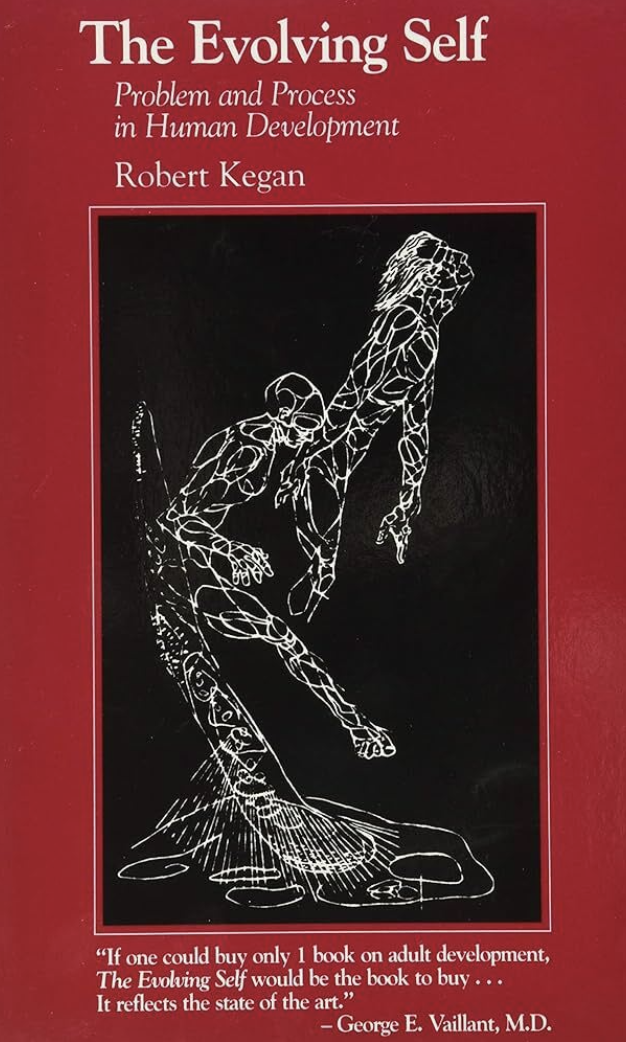
Many familiar stories about human nature portray our species as a finished project. We are bundles of predictable drives and traits playing out in slightly different costumes across history. Robert Keegan begins somewhere else. In his book The Evolving Self he shows human beings to be a meaning-making species whose nervous systems and cultures are built for ongoing transformation. In his view, development is not a childhood phase we outgrow but an open-ended process through which people, across a lifetime and across generations, can reorganize how they understand themselves, one another, and the worlds they build together.
Published in 1982, the same year that Fritjof Capra wrote The Turning Point, the book offers a different way of understanding what a self is and how it changes. Where much of psychology focused on behaviors, traits, or discrete skills, Kegan turned his attention to something more fundamental: the underlying structures of meaning-making that shape how a person experiences self, others, and the world. Human beings are not simply accumulating information over time. We are reorganizing the very frameworks through which information becomes meaningful.
Kegan describes meaning-making as an ongoing activity that begins in infancy and can evolve through a series of increasingly complex balances across the lifespan. From the day we’re born, we’re trying to make sense of the world and our place in it. As we grow, the way we do that can change.
At any given moment, there are things we simply take as reality and other things we can step back and think about. Growth happens when something we once took for granted becomes something we can examine. We stop being run by it and begin to have a relationship with it.
Kegan describes a series of these shifts over a lifetime. A young child is driven largely by impulses and immediate needs. Later, we learn to protect our own interests. Then we become deeply shaped by relationships and the desire to belong. Many adults develop a stronger internal compass, organizing their lives around principles, values, and commitments rather than approval alone. A smaller number learn to hold multiple perspectives at once, seeing that every system—including their own—has limits.
None of these ways of making sense of the world is wrong. Each has strengths. Each also has blind spots. The way we understand ourselves shapes what we notice, what we ignore, and what kinds of responsibilities we are capable of taking on.
One of the book’s most important contributions is its description of the tension between inclusion and autonomy that runs through every stage of development. From the earliest years, humans navigate a double demand: to belong and to be themselves. Kegan traces how different balances resolve—or fail to resolve—that tension, and how many familiar conflicts in adult life, from love and work to citizenship, can be understood as developmental challenges rather than personal defects.
Equally significant is the way Kegan situates individual development within culture and relationship. The self in The Evolving Self is never an isolated unit. It is formed through interaction with caregivers, communities, institutions, and cultural expectations. Growth does not occur in a vacuum. It depends on what Kegan calls a “holding environment”—relationships and contexts that support a person as they are while inviting them beyond their current way of making sense. Biology, psychology, and culture are interwoven. Human beings are organisms whose nervous systems are shaped by other humans and by the worlds they build together.
Read today, The Evolving Self feels like an important bridge between inner life and public life. It gives language to something many people intuit: adults can, and often must, grow in their capacity to hold complexity, conflict, and responsibility if they are to meet the demands of an interdependent and rapidly changing world. It also reframes many social questions. Instead of asking only, “Why are people failing to cope?” Kegan’s lens invites us to ask, “What level of meaning-making are our institutions demanding?” and “What kinds of cultures support adults in continuing to evolve?”
Perhaps the larger lesson Kegan points toward is that growth is not confined to individuals. Human beings are always remaking the worlds they inhabit. We inherit cultures, institutions, and ways of life from those who came before us, but we also revise them, sometimes deliberately, sometimes without noticing. If people are capable of becoming more than they were, then societies may be as well. History, viewed this way, is not simply a record of events. It is a record of learning.
In that light, the enduring value of The Evolving Self lies less in its specific stage labels than in the worldview it proposes. Human beings are not finished at eighteen or twenty-one. They are, for as long as they live, evolving selves—organisms built for ongoing learning, revision, and growth in relationship with others. For a project like Love & Work, that idea provides a strong foundation for believing that “human beings can grow” and “I have a role to play” are not wishful slogans but realistic descriptions of what our species is capable of.
BOOK: The Evolving Self