December 5, 2025
Learning
There is a direct connection between individual growth and institutional adaptability.
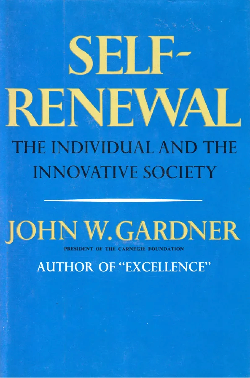
John W. Gardner was a major American public servant and civic reformer in the 20th century. A Republican serving in a Democratic administration, he was Secretary of Health, Education, and Welfare under President Lyndon B. Johnson from 1965 to 1968. He helped implement major Great Society programs, including the launch of Medicare and Medicaid, the enforcement of the Civil Rights Act in schools and hospitals, and the expansion of federal education support for low-income students. Gardner became known for linking government action, citizen responsibility, and the steady pursuit of excellence.
He published Self-Renewal: The Individual and the Innovative Society in 1964. In it, he argues that the central task of a free society is continual renewal—of people, institutions, and culture—so we can face new challenges without falling into stagnation. Renewal, he says, depends on habits of learning, self-examination, and responsibility, not technical fixes or charismatic leaders.
Gardner points out that individual growth and institutional adaptability are deeply connected: rigid, fearful people create rigid, fearful institutions, while curious, responsible people make renewal possible at every level.
For those of us who refuse to believe that today’s ugliness in Washington means the whole human experiment has failed, Gardner offers an important reminder: human beings and human systems are always moving toward growth or stagnation. There is no permanent steady state.
His ideas read like the beginnings of a Love & Work Manifesto:
- Stagnation shows up as defensiveness, nostalgia, fear of change, and clinging to old roles and identities.
- Honest self-knowledge—seeing our own defenses, biases, and blind spots—is the starting point for real change.
- Change is inevitable and speeding up; the real question is whether we adapt creatively or react out of fear.
- Efforts to freeze the status quo create brittleness and eventual crisis.
- Institutions move through life cycles: creation, growth, routine, and decline.
- Renewal requires stepping back, questioning purpose, pruning outdated practices, and welcoming new ideas and people.
- Fear, rigidity, status anxiety, and the craving for security push us to avoid new experiences or dissenting voices.
- Overcoming these inner obstacles by building courage, openness, and resilience is just as important as any structural reform.
More than 60 years after he wrote these ideas, we'd be smart to start to listen to him.
BOOK: Self-Renewal: The Individual and the Innovative Society