June 5, 2026
Learning
The challenge before us is learning to see ourselves, our communities, and the living world not as separate parts, but as participants in a larger web of relationships.
A turning point is not the moment when everything suddenly gets better. It’s the moment when enough of us admit that the old map no longer matches the ground under our feet. The confusion, conflict, and instability of these times may be signs not that the transition is failing, but that it’s already in motion.
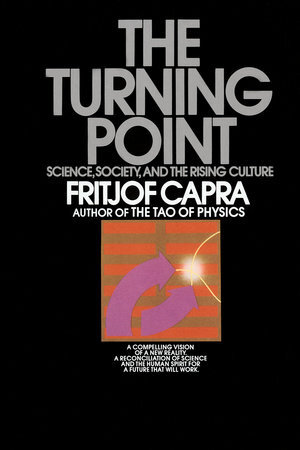
Fritjof Capra published The Turning Point: Science, Society, and the Rising Culture in 1982. Read from today, his perspective feels eerily current and genuinely essential. At a time when environmental concern was still considered fringe, systems thinking mostly lived in universities, and the internet hadn’t yet rewired daily life, Capra noticed something many were missing: the crises erupting across modern life were not separate problems. They were symptoms of a deeper crisis in how we understand the world we live in.
The book’s core claim is simple, and by now, almost familiar. Many of the voices I gather at Love & Work point toward the same conclusion. The worldview that powered modern industrial civilization is no longer adequate to the challenges we face.
For several centuries, Western societies have looked at the world through a mostly mechanistic lens. Following thinkers like Descartes and Newton, we learned to see reality as a machine made of separate parts. That view was extraordinarily productive. It helped fuel scientific breakthroughs, technological innovation, industrial expansion, and unprecedented material wealth. But, as Capra argued, it also trained us to treat living systems as if they were machines we could control, optimize, and manage in isolation from their larger contexts.
The bill for that misunderstanding started to arrive everywhere. In medicine, we focused on treating diseases rather than cultivating health. In economics, growth became the primary measure of success, no matter the social or ecological cost. In agriculture, industrial efficiency often stripped away soil health, biodiversity, and long‑term resilience. In politics, fragmented institutions struggled to respond to deeply interconnected crises.
Capra’s plea was straightforward and radical: these problems share a common source—a failure to see that life is fundamentally relational.
Drawing on developments in biology, ecology, cybernetics, and the emerging sciences of complexity and self‑organization, he described a different way of seeing. Living systems are not piles of parts. They are networks of relationships. Organisms live within ecosystems. Individuals live within communities. Economies live within societies and within the biosphere. The health of the whole depends on the quality of the relationships among its parts.
As researchers studied ecosystems, cells, feedback loops, and complex adaptive systems, they found that the most important qualities of life arise from patterns of connection, not from isolated components.
Capra believed this shift was more than a technical correction inside science. It signaled the beginning of a cultural transformation. The “rising culture” of his subtitle pointed to a worldview grounded in interdependence, ecological awareness, participation, diversity, and respect for living systems.
He was also clear—and here he feels especially close to our current moment—that such a transition would be anything but smooth. Old institutions, habits, and assumptions don’t evaporate just because better ideas show up. They hang on until their limits become impossible to ignore. Transitional periods are messy: uncertainty, conflict, and competing stories about how the world works are part of the process.
More than forty years later, many of the conditions Capra named have only intensified. Climate disruption, political polarization, economic inequality, biodiversity loss, and social fragmentation now feel like defining features of our era. At the same time, many of the alternatives he pointed to have grown. Regenerative agriculture, systems thinking, renewable energy, ecosystem restoration, community‑based governance, and holistic approaches to health have moved from the far edges closer to the center.
The enduring value of The Turning Point lies less in any specific forecast and more in the framework it offers for understanding change. Capra invites us to see today’s crises not as isolated failures, but as evidence that an old worldview is reaching its limits. Whether the transition succeeds is still an open question. What the book suggests is that the path forward begins by learning to see ourselves, our communities, and the wider living world not as separate parts, but as participants in a larger web of relationships.
BOOK: The Turning Point, Science, Society, and the Rising Culture