May 8, 2026
Civics
We don’t have to wait for the whole system to change to begin living differently.
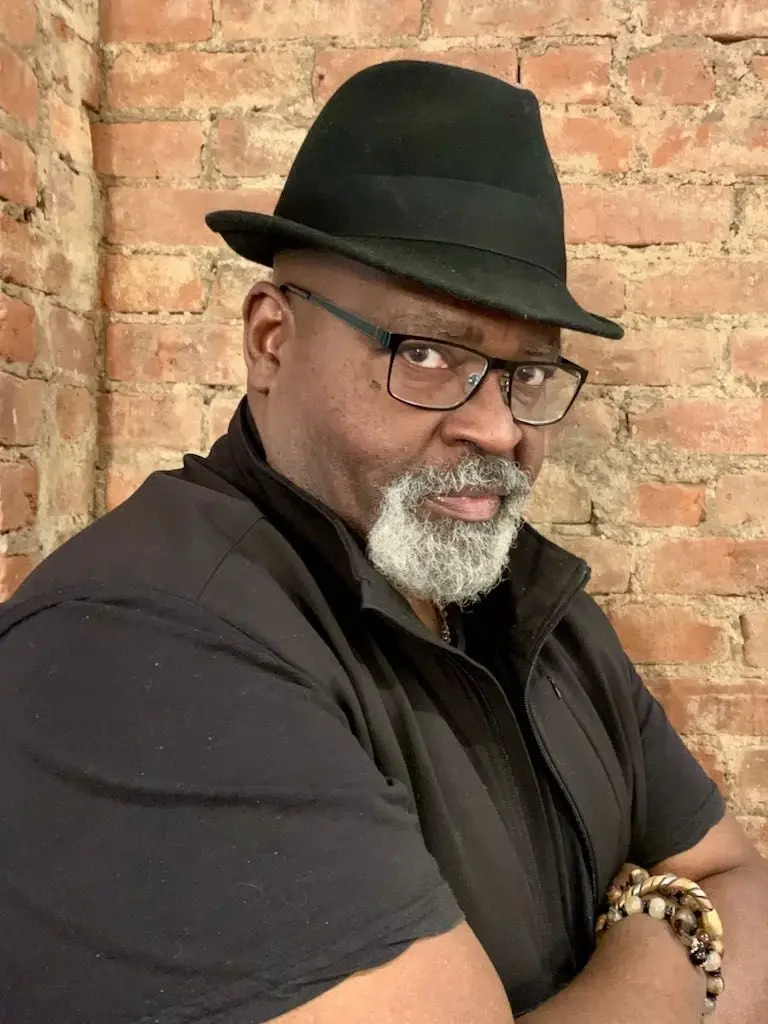
Ed Whitfield is a Black freedom movement organizer, philosopher of self‑reliance, and blues‑loving instrument maker who insists that communities can and must create their own “huts” of collective freedom and dignity. Photo via Seed Commons
Ed Whitfield has spent a lifetime working across the long arc of American reform—civil rights, anti-war organizing, and, more recently, community economics. What emerges is not a grand theory but a disciplined practice: a way of thinking about freedom that is concrete, local, and cumulative.
His biography matters because it grounds his worldview. Raised in Little Rock, a leader in the 1969 Black student takeover at Cornell, later co-founder of the Fund for Democratic Communities, Whitfield has also lived as a working musician and instrument maker in Clarksdale, Mississippi. His thinking reflects all three worlds—movement politics, new system design, and cultural life.
In this article, he offers a promising and actionable perspective: freedom is not only a destination after systemic change; it can be built, in partial and provisional ways, in the present.
He calls these efforts “liberated zones”—places where people organize aspects of economic and civic life on different terms. Not utopias, but working arrangements: local food systems, education rooted in lived experience, shared cultural production, and practices of mutual care. They are limited and may be fragile, but they are real—and for Whitfield, that reality matters.
I like how he’s trying to steer between two familiar patterns of response to oppression. On one side is the kind you see all day in social feeds—hot takes, outrage, quick judgments, instant certainty. These are fast responses that react to the latest headline but don’t go very deep or stay with a problem long enough to actually change it.
On the other side is intellectual analysis. Written for specialists, shaped by academic norms, too often it remains sealed off and difficult for non-experts to enter. It can be precise and insightful, but can feel very distant from the people actually living with the conditions being described.
Whitfield is aiming for something more useful: a way of understanding what’s going on that people can grasp and act on. He raises several themes that are edifying to unpack:
First, a shift in time: freedom is not deferred; it is assembled incrementally. This requires refusing to normalize exploitative systems simply because they offer comfort to some.
Second, the complication of privilege. Partial inclusion can dampen the impulse for deeper change.
Third, imagination—what he calls “freedom dreams.” Not rhetoric, but a social capacity. Without it, alternatives remain unseen.
Finally, power. Drawing in part on economist, Lloyd Hogan, Whitfield examines how wealth and control are produced and captured—not for theoretical completeness, but to clarify where intervention is possible.
What he offers is a shift in emphasis. Rather than waiting for large-scale change, begin locally. Disciplined, cooperative action is how larger change becomes thinkable.
For those unsettled by the aggressive consolidation of power and privilege in today’s politics—and frustrated by how distant better alternatives can feel—this lands with a sense of clarifying direction and agency.
The premise is doable: people can build pockets of liberation where they already live, with the people already around them. Freedom is not achieved all at once. It is constructed, “a little bit at a time,” through efforts that meet real needs while quietly changing the terms of everyday life.
These “liberated zones” serve two roles. They are immediate refuges—spaces where more cooperative ways of living can take hold. And they are seedbeds. Over time, they build experience, relationships, and proof that a different system is not only imaginable, but buildable.
Whitfield offers less a solution than a reorientation: away from waiting, and toward making.
ARTICLE: What Must We Do To Be Free? On The Building of Liberated Zones