May 8, 2026
Teaching
Thinking is a practice that can be cultivated, and the arts are one of the most powerful ways we learn how to do it.
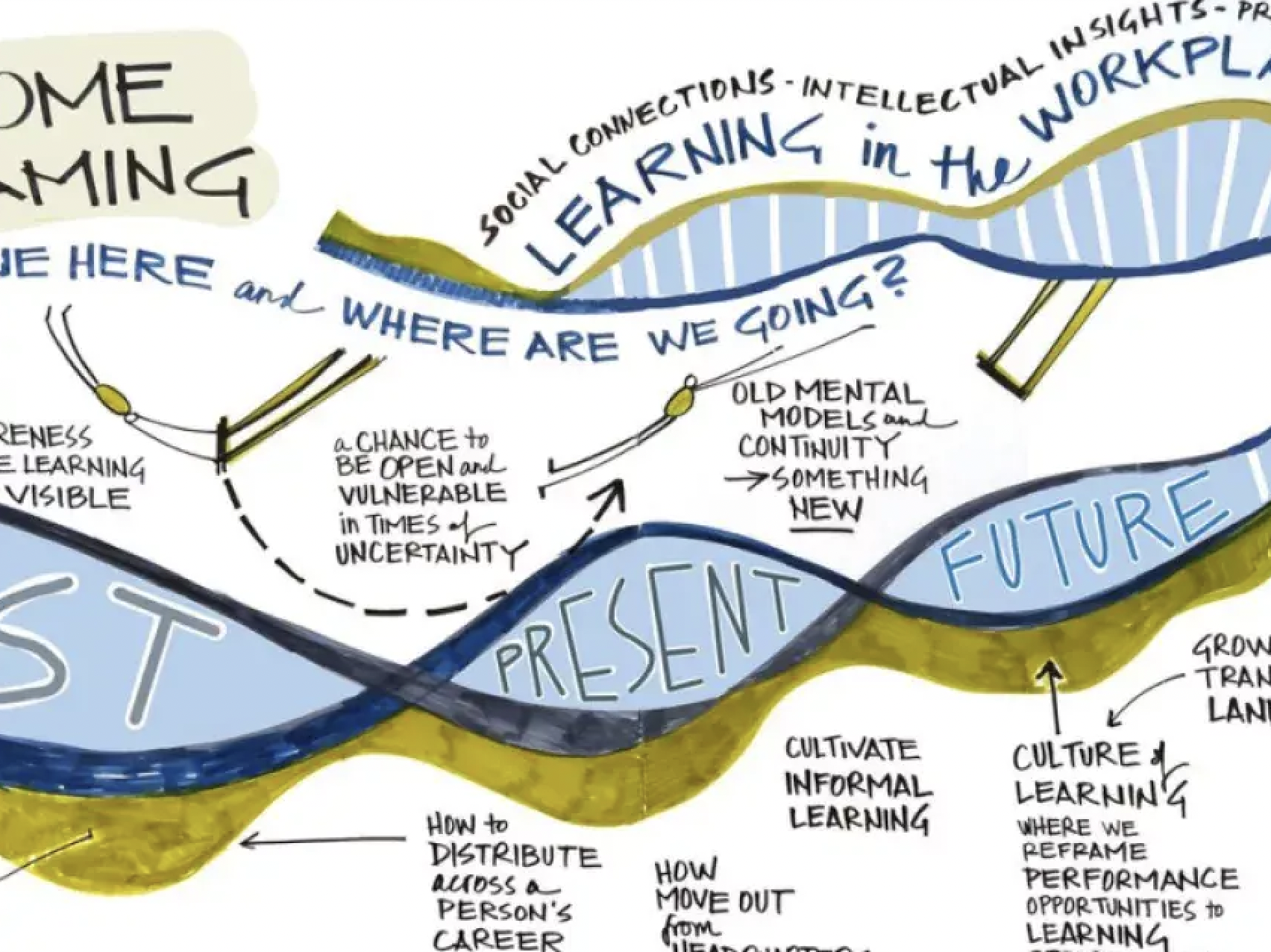
A snippet of a sketchnote from a Learning Innovations Laboratory (LILA) session. A program by Project Zero, LILA gathers several times a year. Each gathering brings in outside academic experts to present current research, which is then discussed and pressure-tested by the group.
Nelson Goodman, an American philosopher, saw the arts as a way of knowing—not decoration, but a fundamental way we understand the world. In the 1960s, he noted that despite their influence, we knew almost nothing—“zero”—about how people learn through the arts. No one had studied artistic learning with the rigor given to other fields. With this in mind, in 1967 he founded Project Zero at the Harvard Graduate School of Education.
Now the oldest research center at Harvard Ed, Project Zero conducts ongoing research, develops practical tools and frameworks, and offers professional teaching—courses, workshops, and programs—for educators and learners across contexts. Over six decades, the center has produced a set of widely used frameworks that have had profound influence on our understanding of how learning happens:
- Multiple Intelligences — Howard Gardner’s landmark Frames of Mind (developed at PZ) fundamentally challenged the fixed, single-axis view of IQ that had dominated for nearly a century, and directly seeded differentiated instruction and project-based learning in classrooms worldwide.
- Visible Thinking / Thinking Routines — simple, repeatable protocols (like “See-Think-Wonder” and “I Used to Think / Now I Think”) that teachers worldwide use to make student reasoning explicit and discussable.
- Studio Habits of Mind — a framework for arts education that articulates what artists actually do when they work, giving teachers a vocabulary for serious pedagogical practice.
- Teaching for Understanding — a curriculum design framework that pushed back against rote learning and toward genuine comprehension and transfer.
Newer work extends into maker-centered learning, play, and how young people engage with digital life. Nearly 3,000 educators engage with PZ’s professional development each year, and the 2025 Impact Report counts 3.3 million website visits and 1,377 educators from 104 organizations attending professional development programs in a single fiscal year.
Behind these ideas is a substantial, open resource library—hundreds of tools, articles, and media, most freely available—alongside ongoing research and professional development for educators across disciplines.
It’s all held together by a simple conviction: thinking is a practice that can be cultivated, and the arts are one of the most powerful ways we learn how to do it.
WEBSITE: Project Zero