May 8, 2026
Teaching
The purpose of education is not to prepare students for the world as it is, but to awaken in them the capacity to imagine the world as it could be.
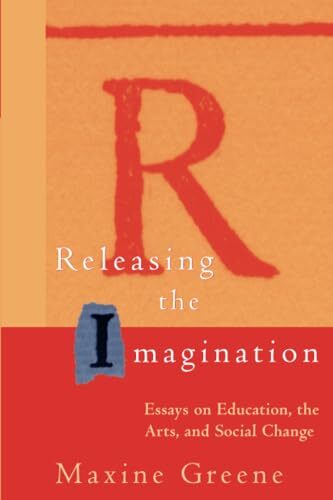
Maxine Greene began her career in the forties, when philosophy of education was an all-male domain. Initially barred because of her gender, she entered her field at Teachers College, Columbia University through the English Department. She went on to become a fierce and articulate advocate for the idea that the purpose of education is not to prepare students for the world as it is, but to awaken in them the capacity to imagine the world as it could be.
She wrote Releasing the Imagination in 1995. In it, she makes the case—one that should be obvious—that imagination is not an add-on to education but its central purpose, and that the arts are its most reliable vehicle. While addressed primarily to teachers, the book ranges far beyond schooling. It is as much a work of philosophy and democratic theory as it is a text on education.
Greene begins by noting that imagination makes empathy possible—“what enables us to cross the empty spaces between ourselves and those we have called ‘other.’” Of all our capacities, she suggests, imagination is what allows us to take alternative realities seriously. From there, she moves through questions of community, pedagogy, and the kinds of social vision schools either cultivate or suppress.
In the book’s second section, Illuminations and Epiphanies, Greene describes teaching as “finding openings” and curriculum as a “search for meaning.” The arts, she argues, have a unique power to “defamiliarize experience”—to break the habits that keep us from seeing clearly. Literature, in particular, can “subvert dualism and reductionism,” making easy generalizations suspect. Genuine encounters with art—participatory rather than passive—can produce what she calls “shocks of awareness,” moments when the familiar becomes strange and new possibilities come into view.
The final section, The Social Imagination, is the most explicitly political. Greene insists that imagination is not merely private or aesthetic but civic. The ability to see things “as if they could be otherwise” is a precondition for democratic life. A citizenry without imagination cannot envision alternatives; it can only sustain or endure what exists. Schools that suppress imagination in favor of standardization are not just educationally limited—they are democratically at risk.
It is clear why this book matters now. Greene was responding to a moment that pushed schools toward standardization, measurement, and the marginalization of the arts. Thirty years later, those pressures have intensified. Her argument—that a democratic society depends on citizens capable of imagining alternatives, and that the arts cultivate that capacity—has only grown more urgent. Releasing the Imagination is not a nostalgic defense of arts education; it is an articulation of what human beings need to remain free.
BOOK: Releasing the Imagination. Essays on Education, the Arts, and Social Change