July 4, 2025
Learning
"I truly think that autodidacts are responsible for all that is good and great about alternative culture."
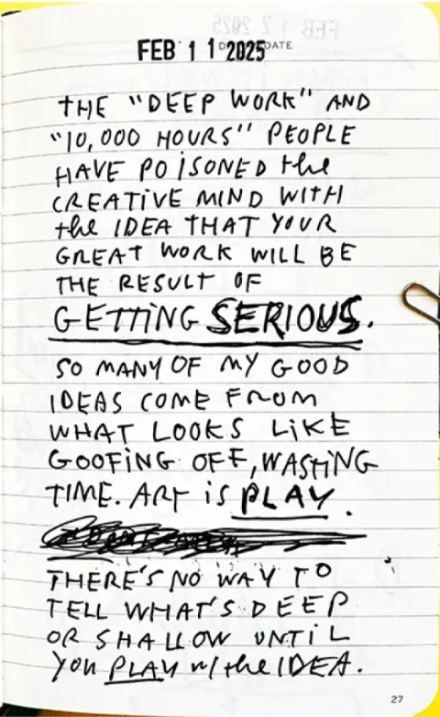
Austin Kleon calls himself a writer who draws. He’s someone who finds joy in research. This is a page from one of his notebooks.
Celine Nguyen is a designer and writer from California. She publishes a great newsletter that explores "literature, design, fashion, technology, phenomenology, perfume, and Proust"—a list that only skims its depth and breadth. It is a beautifully eclectic scrapbook of ideas and discoveries.
In a recent essay, Nguyen frames research as a leisure activity—something fueled by curiosity, play, and personal passion rather than professional obligation.
As someone who researches for fun (you’re reading the results), I relate to her insight: research can be a deeply personal, intuitive journey.
This kind of research isn’t limited to academic settings. It includes whatever you're naturally drawn to—pop culture, urban planning, recipes. One interest leads to another. The joy lies in the unexpected connections, and in following where your attention wants to go.
ARTICLE: Research as Leisure Activity