May 22, 2026
Nature
Climate is not only about carbon in the atmosphere. It is also about the movement of water through living systems.
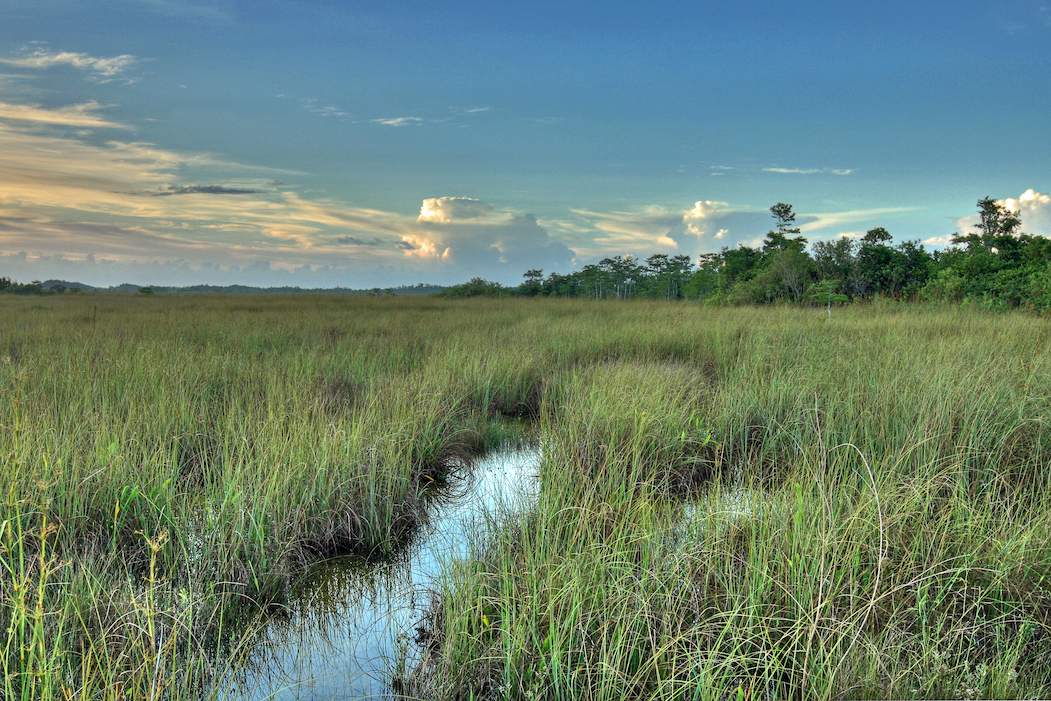
Sawgrass Prairie, National Park Service Photo by G. Gardner
In the 1950s, the Gulf American Corporation attempted to transform 114,000 acres of swamp into Golden Gate Estates, promoted at the time as the largest rural subdivision in the United States. Developers carved an immense grid of roads across the landscape and dug four parallel canals stretching nearly fifty miles in an effort to drain the land for development. When the project failed, it left behind a damaged and drying ecosystem, with the canals continuing to siphon water from the wetlands and disrupt the coastal estuaries where that water once naturally flowed.
What Gulf American failed to understand was that water in motion is what creates and sustains life in wetland ecosystems.
The developers treated standing water as an obstacle to remove rather than the circulatory system of a living landscape. They did not grasp that the Everglades’ shallow, slow-moving sheet flow—what Marjory Stoneman Douglas famously called the “River of Grass”—was regulating regional climate, filtering nutrients, recharging aquifers, and sustaining an intricate web of life stretching from microorganisms to the Florida panther.
By draining the swamp, they were not simply removing water from one place. They were severing relationships within a vast hydrological system extending from inland marshes to coastal estuaries and disrupting cycles that had sustained the region for thousands of years.
That was then. Today, in what may be one of the most ambitious ecological restoration efforts ever attempted, scientists and engineers are demonstrating that catastrophic environmental damage can, at least in part, be reversed—if we are willing to work with natural processes rather than against them.
The Picayune Strand Restoration Project, completed in January 2026 after more than two decades of painstaking work, has restored natural water flow across roughly 55,000 acres of damaged wetlands. Roads have been removed, canals plugged, and water allowed once again to spread slowly across the landscape in ways that resemble the original hydrology of the Everglades.
But this is not merely a story about engineering or environmental repair. It is also a lesson in the hidden intelligence of living systems.
What ecologists have learned in bringing parts of the Everglades back from the brink challenges some of our deepest assumptions about climate and restoration. Water moving slowly through intact landscapes does far more than support wildlife. It moderates temperature, stores carbon, replenishes aquifers, regulates biodiversity, buffers storms, and creates the conditions under which life itself can flourish.
The larger insight is surprisingly simple: climate is not only about carbon in the atmosphere. It is also about the movement of water through living systems. And when those systems are broken, the consequences ripple outward across entire regions. When they are restored, life begins organizing itself again.
ARTICLE: Restoring the Flow: A Milestone in the Revival of the Everglades