May 15, 2026
Nature
What if our deepest crisis is not economic or even ecological, but a crisis of love?

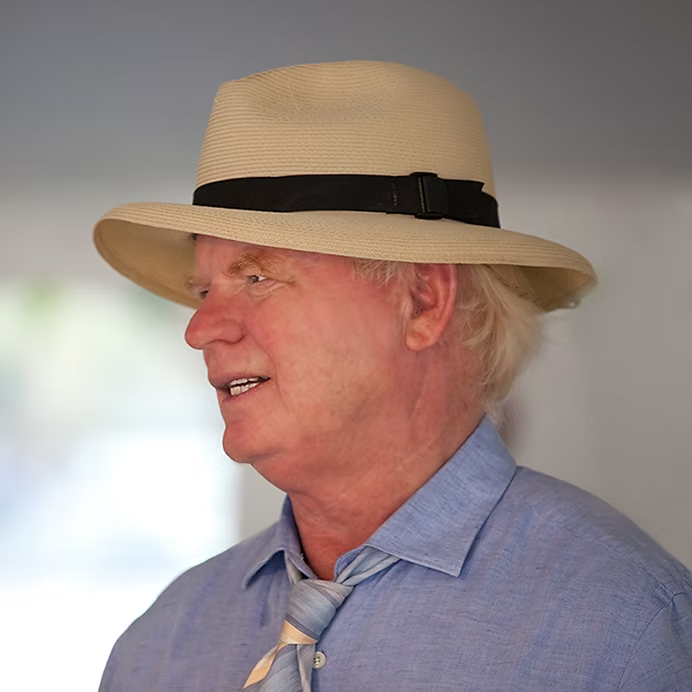
Andreas Weber is a German biologist, philosopher, nature writer, and journalist whose work sits at a rich and fertile intersection of science, philosophy, and ecology. Trained in both marine biology and cultural studies, he later earned a PhD in philosophy focused on nature as a meaning-making phenomenon.
What makes Weber so interesting to follow is the range of ideas he holds and weaves together. He is scientifically rigorous enough to publish with the MIT Press, philosophically serious enough to have worked closely with Francisco Varela—one of the founders of the theory of autopoiesis, the idea that living systems continuously create and maintain themselves—and poetic enough to write lines like “being alive is an erotic process.”
In addition to being a great elevator pitch, that statement is the organizing thesis of his book Matter and Desire. The book opens with a surprising proposition: what if our deepest crisis is not economic or even ecological, but a crisis of love?
By “love” and “eros,” Weber does not mean sentimentality. He means something biological and structural: the drive of living things toward relationship, exchange, and transformation. Eros, in his usage, is the force that pushes life toward increasing complexity and connection. Where physics describes a tendency toward entropy and dissolution, life continually generates new forms of individuality and interdependence.
To be alive, Weber argues, is to be in constant transformation through contact with others. Every organism—from a dividing cell to a bird at dusk—is becoming more fully itself through relationship with what is outside of itself. The boundary between self and world is not a wall but a membrane: the place where exchange and transformation occur.
From this he draws a radical ecological conclusion. The impulse toward connection is not a human emotion projected onto nature; it is woven into life itself. Ecology, properly understood, becomes the study of relationship—how forms of life create conditions together that none could create alone.
The ecological crisis, Weber suggests, is therefore not only a crisis of policy or economics. It is also a crisis of meaning. We inherited a worldview that treated nature as inert matter, available for extraction and use. In doing so, we lost the felt experience of participating in a living world.
Weber calls his framework “poetic materialism.” It remains grounded in bodies, ecosystems, and biology, while insisting that meaning, feeling, and experience are as real as matter and energy.
The book’s final argument is both simple and audacious: to protect life on Earth, we must relearn how to love—not as moral performance, but as a biological and philosophical practice. To love, in Weber’s sense, is to allow oneself to be changed through relationship with what is other. That, he suggests, is what living systems already do. Our biggest challenge is to remember that we are one of them.
BOOK: Matter and Desire. An Erotic Ecology