April 24, 2026
Learning
The way we come together is itself a technology — and we can upgrade it.
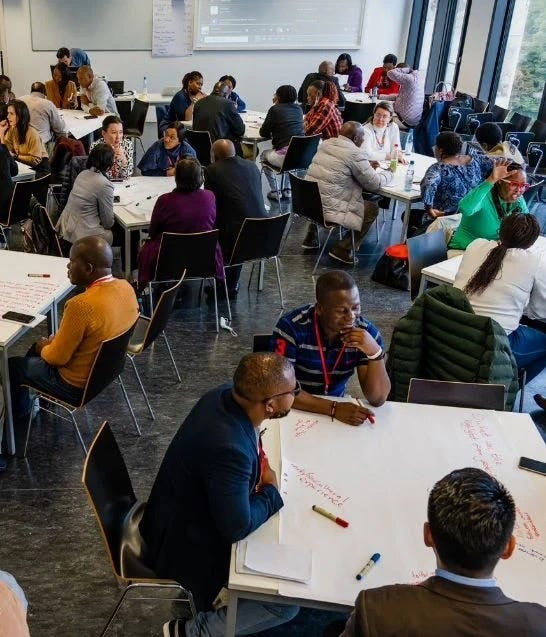
In 2012 I was asked to help Reos Partners articulate their brand. It turned out to be a graduate seminar disguised as a consulting project — an immersion in the idea that how we come together to solve problems matters as much as the solutions we reach. Photo via Reos Partners
Picture a meeting you have attended recently about something that genuinely mattered — a community problem, an organizational challenge, a question that required the best thinking of everyone in the room. Chances are it followed a familiar script. An agenda was circulated. A few people spoke most of the time. Someone at the front of the room held a marker. A decision was made, or deferred, by whoever had the most authority or the most persistence. People left either mildly frustrated or mildly relieved, and most of what they actually knew and felt about the problem stayed locked inside them, unexpressed.
This is not a minor inefficiency. It is the dominant operating system of nearly every institution we have built — and it is structurally inadequate to the complexity we face. The problems that matter most right now — how to rebuild civic trust, how to govern shared resources, how to adapt communities and organizations to conditions that keep changing faster than any single expert can track — are not problems with known solutions waiting to be handed down. They are problems that require the genuine intelligence of everyone affected by them. And that intelligence almost never surfaces in a meeting run the way most meetings are run.
Something different has been developing, quietly and persistently, for the better part of a century.
It began with a handful of researchers and practitioners who noticed what conventional group structures were suppressing. In the 1940s, social psychologist Kurt Lewin discovered that people support changes they help shape, and that groups have a kind of intelligence that exceeds the sum of their individual members — but only under certain conditions. Carl Rogers showed that the quality of a relationship, not the expertise of the helper, determines whether real learning and change happen. Paulo Freire observed that genuine education is never the transfer of knowledge from expert to passive recipient, but always a collaborative inquiry in which both parties are changed. Physicist David Bohm spent the last decades of his life developing a practice he called Dialogue — not debate, not discussion, but a form of collective thinking in which a group suspends its assumptions and listens for meaning to emerge that no one could have arrived at alone.
These were not marginal ideas. They were findings — about how human intelligence actually works when it is not distorted by hierarchy, fear, or the performance of certainty.
Out of this early research, a distinct field of group experience and collective learning has begun to take shape—global in reach, cross-sector in application, and still evolving in form. By way of example, I point to four organizations and practitioners that illustrate what this work looks like in practice. Reos Partners designs multi-stakeholder processes for true systems change. They do it by convening people across conflicting interests to find shared solutions to problems that are too complex for any single actor to solve. The Presencing Institute, founded by Otto Scharmer at MIT, offers Theory U — a structured journey through deep listening, collective sensing, and prototyping that helps groups lead from the emerging future rather than from the habits of the past. Art of Hosting is a global practitioner network that blends conversational methods — World Café, Open Space, Appreciative Inquiry — to unlock the wisdom already present in any room. And The Circle Way, founded by Christina Baldwin and Ann Linnea, offers the most elemental intervention of all: change the shape of the room, put purpose in the center, distribute the speaking role equally, and watch what becomes possible.
While each is distinct in emphasis and approach, a shared grammar underlies them all—four foundational shifts from the dominant operating model:
From parts to wholes. You cannot understand or change a system by working on its components in isolation. The patterns of relationship are primary.
From expertise to emergence. The most important knowledge is not held by the expert at the front of the room. It lives in the group, in the field between people, in the encounter between different perspectives.
From transmission to transformation. Learning that matters is not the transfer of information but the restructuring of how one sees — and that restructuring happens through relationship, not lecture.
From control to participation. The attempt to impose order on human systems from outside and above is not only ineffective — it suppresses the very capacities (creativity, generosity, self-organization) that make human systems thrive.
Taken together, these four shifts constitute a genuinely different way of working. They are not idealistic. They are practical. And their application does not require a perfect setting or a specially trained population. They have been tested in hospitals and corporations, in post-conflict communities and city planning processes, in schools and congregations and community organizations of every kind.
Buckminster Fuller said that you never change things by fighting the existing reality — that to change something, you build a new model that makes the existing model obsolete. That is exactly what this field has been doing, meeting by meeting, circle by circle, conversation by conversation. Not by arguing that conventional hierarchies are wrong, but by demonstrating that something else is possible — that groups of human beings, given the right conditions, are capable of a quality of thinking and deciding that the boardroom and the podium were never designed to produce.
The problems we face are genuinely complex. They will not yield to the operating system that helped create them. The good news is that a different operating system already exists, has been tested in the hardest conditions imaginable, and is available to anyone willing to learn it. It begins with a deceptively simple act: changing how we sit, who speaks, what we listen for, and what we believe a room full of people is capable of becoming.
(I’ve recently been stepping back to summarize the primary themes that shape Love & Work. This essay is part of that series.)