April 10, 2026
Nature
The living world is not a backdrop. It is a teacher.
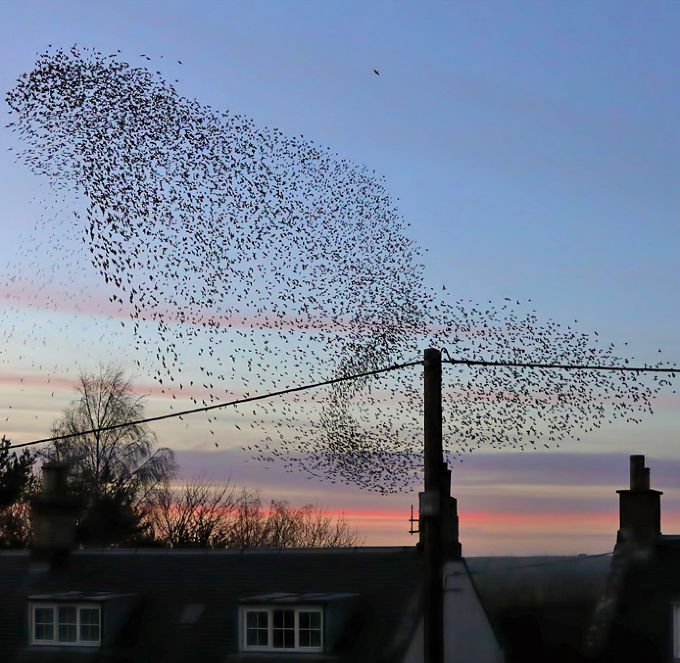
A murmuration of starlings over the English countryside. Thousands of birds, no leader, no blueprint — just each individual responding to its seven nearest neighbors, and from that simple rule, something coherent and breathtaking emerges. The living world has been running successful experiments in collective intelligence for far longer than we have. Photo by Walter Baxter
We built our civilization on a single, confident assumption: that the natural world is a resource. Not a teacher, not a community, not a relative — a resource. Something to be surveyed, extracted, managed, and, if necessary, replaced. This assumption is so embedded in our institutions, our economics, and our education that most of us have spent our lives inside it without ever having to name it.
It is worth naming now, because the costs have become too obvious to ignore. And because there is a genuinely different assumption available to us, one with deep roots in Indigenous knowledge, emerging support from ecology and complexity science, and a growing number of practitioners willing to act on it.
The alternative assumption is this: the living world knows things we don't. And if we are willing to learn from it rather than simply use it, it will teach us something we urgently need.
Ecologist Suzanne Simard spent decades in the forests of British Columbia watching trees do what our economic models told us they couldn't: cooperate. Through underground networks of mycorrhizal fungi — what she came to call the "wood wide web" — Douglas firs share carbon with struggling neighbors, older "mother trees" funnel nutrients to seedlings, and the whole forest coordinates responses to stress and threat in ways that no individual tree could manage alone. What looks, from above, like a collection of separate organisms is, from below, a single, interwoven community engaged in something very close to mutual aid.
This is not metaphor. It is how forests actually work. And it raises a question that is not merely biological: if the most ancient, resilient systems on Earth are organized around reciprocity rather than competition, what does that tell us about the systems we should be building?
Robin Wall Kimmerer, a botanist and member of the Citizen Potawatomi Nation, argues that the Western scientific tradition trained her to look at plants as objects — things to be classified and measured. It was her Indigenous grandmother's way of knowing, and years of patient attention to the natural world, that taught her something science alone had left out: that the plants were, in some meaningful sense, already giving. The serviceberry, she points out, produces far more fruit than it needs. Its abundance is an offering — a design for generosity built into the organism's very structure. Kimmerer asks what it would mean to organize an economy the way a serviceberry organizes its harvest: producing enough to share, expecting reciprocity, measuring success not by accumulation but by the health of the relationships the giving sustains.
These are not romantic ideas. They are structural ones. Kimmerer and Simard are not asking us to hug trees. They are asking us to reconsider what intelligence looks like, what resilience requires, and who — or what — we are willing to count as a teacher.
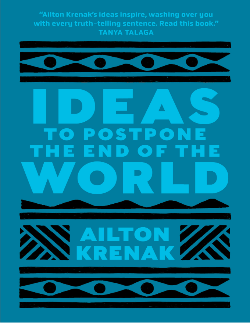
Ailton Krenak, the Brazilian Indigenous philosopher and activist, goes further. He argues that the estrangement from nature is not just ecological but existential — that when we separated "humanity" from "nature" and placed ourselves above and apart from the living world, we did not gain dominion; we lost orientation. We lost the relationships and reference points that had, for most of human history, helped us understand who we were, what we owed, and how to live. The current convergence of crises — ecological, democratic, psychological — is, in his reading, the consequence of that forgetting. Recovery begins not with new technologies, but with new humility: the willingness to be instructed, once again, by what is older and wiser than we are.
None of this requires abandoning science or returning to a past that cannot be recovered. It requires something more modest and more difficult: paying the kind of attention that actually learns something. What do diverse, interwoven systems know about resilience that monocultures do not? What do mycorrhizal networks know about sharing that shareholder models have forgotten? What do forests, watersheds, and prairies know about the long game that our quarterly reports cannot see?
The living world has been running successful experiments in survival, cooperation, and adaptation for three billion years. We have been running ours for a few thousand, with results that are, at best, mixed. This is not an argument for despair. It is an argument for a different kind of curiosity — one humble enough to enroll in the oldest school still in session.
Love & Work pays attention to the living world not as scenery, but as teacher. The goal is not to catalog nature's wonders from a safe distance. It is to notice what the more-than-human world is demonstrating about how to stay alive together — and to ask, seriously, what we might do differently if we actually took the lesson.