March 20, 2026
Culture
We need a new story.
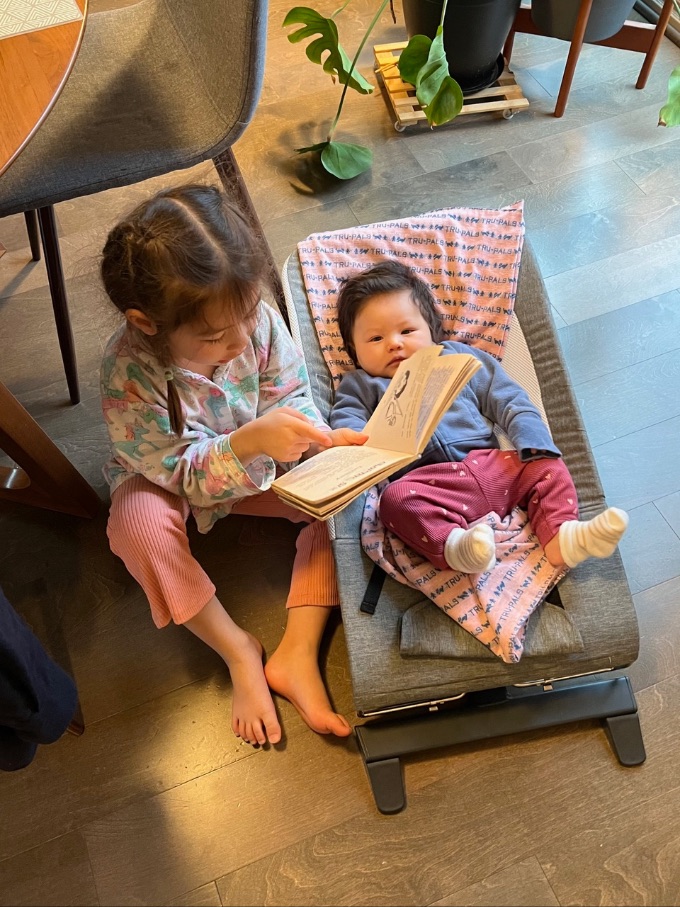
My granddaughters enjoying story time. At the end of the day I want to try to be a good ancestor.
For centuries, many of us in the industrial West have lived inside a tale that casts the world as raw material and humans as its managers, consumers, and winners or losers. This old narrative has powered extraordinary innovation, but it has also delivered us to the brink: a heating planet, frayed democracies, mass extinction, and a pervasive sense that life is speeding up and thinning out at the same time. In that light, the question is not just what policies we adopt or which technologies we deploy, but what story we are living in—and whether it can still hold.
Modern science offers a different starting place. Cosmology and evolutionary biology describe a universe that has been unfolding for billions of years, giving rise to galaxies, stars, Earth, ecosystems, and, eventually, beings capable of reflection and care. In that frame, humans are not spectators standing outside nature; we are one local expression of a much older, wilder creativity. The task is not to dominate a dead world, but to participate in a living one with more maturity, humility, and imagination.
If that’s true, then story is not ornament but infrastructure. The narratives that shape our sense of progress, value, success, and “the good life” quietly code our institutions, economies, and technologies. They decide whether growth means extracting as much as possible, or tending relationships that allow many forms of life to flourish. A new story would ask us to see ourselves as participants in a larger Earth community, to measure prosperity by the health of watersheds and neighborhoods, and to treat our daily choices—how we eat, move, work, and pay attention—as ways of rehearsing a different civilization.
We cannot simply wait for that story to arrive fully formed from somewhere else. It has to be composed in real time, by people willing to experiment at the edges, to accompany the old order as it unravels without turning away from its harms, and to protect those most exposed to its violence. Designing a livable future, in this sense, is less about mastering the planet and more about learning to tell and live a story in which the long creativity of the universe can still move through us, for the sake of the whole.
A new story cannot be handed down as doctrine; but it can be stitched together from experiments already underway—communities reclaiming commons, movements centered on repair, and artists and educators practicing a different scale of value and belonging. In that sense, the cosmology I’m reaching for is less a finished theory than a field of possibilities.
You do not need another lecture on planetary emergency; you already know the stakes. My work here is to notice and name the patterns that are already breaking with the old script and bring them into view alongside your own questions and constraints. It's my hope that from this vantage point we can see a new story emerge.
.png)