February 27, 2026
Culture
A local response to global crises in agriculture, textiles, and climate
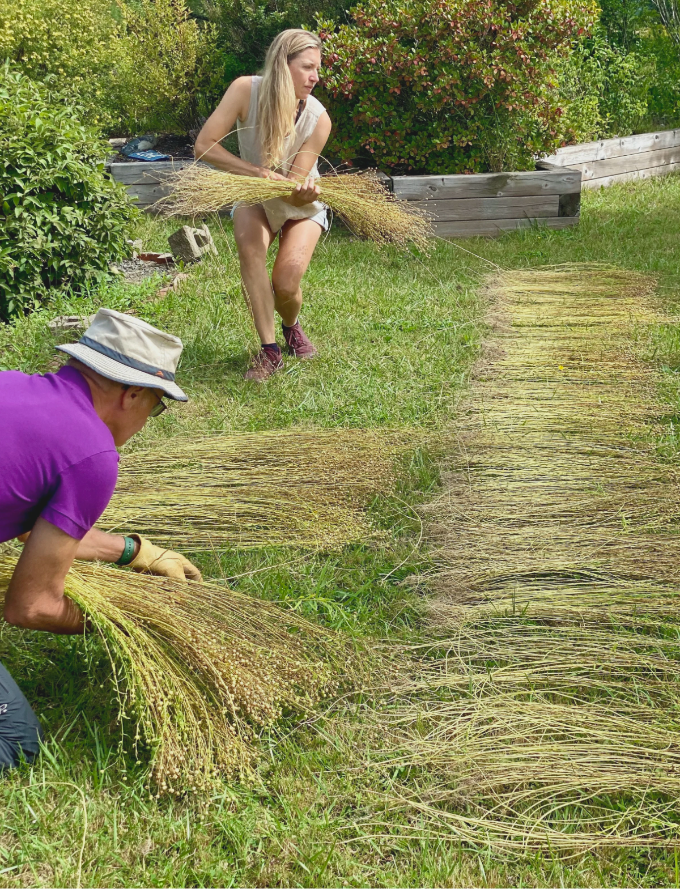
Jennifer Green runs the “Flaxmobile,” a mobile teaching project traveling across Nova Scotia to help smallholders and organic farmers grow and hand-process flax, sharing the full seed-to-cloth experience. Photo by Jody Nelson
In Nova Scotia, a small but vivid flax-to-linen experiment is quietly rebuilding local textile capacity by braiding together history, culture, small farms, and just-enough machinery. Its aim is not to “compete” with global linen, but to grow a place-based fabric of resilience: cloth that reflects a particular land, climate, and community.
Across many regions, similar projects are part of a broader movement toward bioregional fiber systems—asking what it would mean if our wardrobes were as local as our farmers’ markets. Rooted in heritage skills and community organizing, these efforts are emerging as practical responses to overlapping crises in agriculture, industrial textiles, and climate.
Designer Zoe Gilbertson uses a tree-and-mycelium metaphor: culture, memory, and community life form a network beneath the surface, nourishing the “roots” of early innovators. These roots support the “trunk” of working farms and small processing hubs, which in turn produce the “branches and fruit” of diverse fiber products, crafts, and livelihoods.
At the center are entrepreneurs willing to invest in specialized flax machinery and infrastructure long before there is a clear market. Their work reframes value: the goal is not volume or profit maximization, but the cultivation of locally rooted systems where value circulates through connection, shared learning, and regional resilience.
This perspective raises a deeper question: what if the purpose of an economy were to nourish life, connection, and resilience in a particular place, rather than to maximize extraction, speed, and growth at any cost?
ARTICLE: Revisiting the Nova Scotia Flax to Linen Ecosystem
RELATED ARTICLE: The Flaxmobile