March 13, 2026
Habitat
Dense urban housing can be beautiful, low‑carbon, and socially generous at the same time.
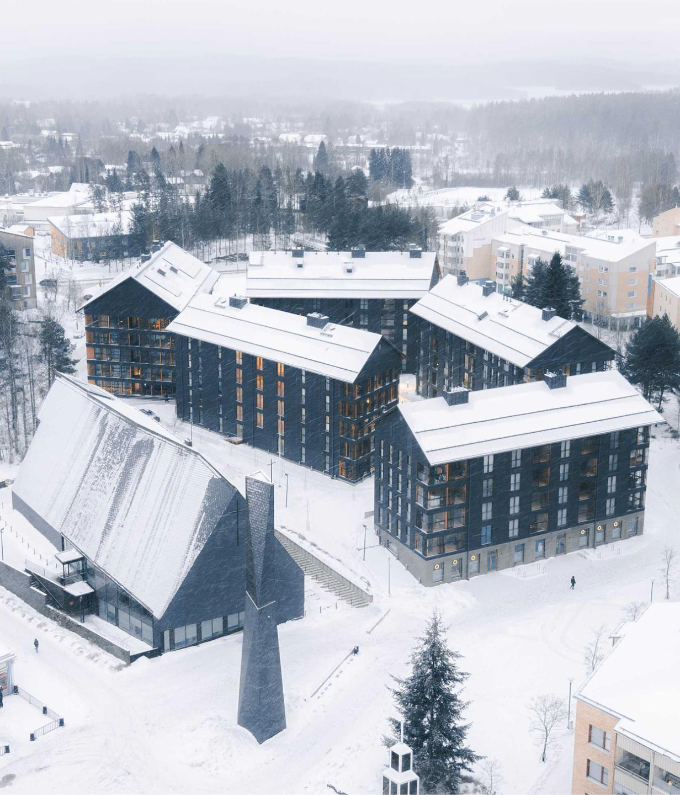
Photo © Kalle Kouhia
Kuokkalan Kalon, a newly completed timber residential block in Kuokkala, Finland, offers a glimpse of how cities can grow without losing their character—or their humanity.
Built beside Kuokkala’s wooden church in the city of Jyväskylä, the project was designed to feel calm and house-like, fitting gently into the neighborhood while allowing the church to remain the visual landmark. Instead of competing with the past, the architecture strengthens the local identity that was already there.
The development includes five residential buildings and about 160 apartments, mixing rental homes, owner-occupied units, right-of-occupancy housing, and senior apartments in one place. Different ages, abilities, and incomes live side by side.
Just as important as the homes themselves is how the place encourages everyday connection. All of the entrances face a sunny inner courtyard filled with planter boxes, pergolas, a fountain, and a playground for multiple generations. Residents pass through this shared space whenever they come or go, turning routine movement into small moments of encounter.
Common spaces are woven into daily life as well. Mailboxes, laundry rooms, shared kitchens, and other gathering spots sit beside the stairwells at courtyard level, so ordinary tasks—getting the mail, doing laundry, making coffee—become natural chances to meet a neighbor.
Ground-floor community rooms and church-related spaces open toward both the courtyard and the surrounding streets, softening the boundary between the housing block and the wider neighborhood and creating easy places for people to gather.
The project also shows how dense housing can dramatically lower its environmental footprint. The buildings are constructed from timber, heated with geothermal energy, supported by solar panels that benefit residents, and built using demolition materials reused directly on site.
The result is a simple but powerful reminder: when we design housing as a place for relationship—between neighbors, buildings, and the land—density can become not just efficient, but beautiful.
ARTICLE: Collaboratorio