March 6, 2026
Civics
What kind of culture and institutions make it possible for ordinary people to correct their leaders—before it’s too late?
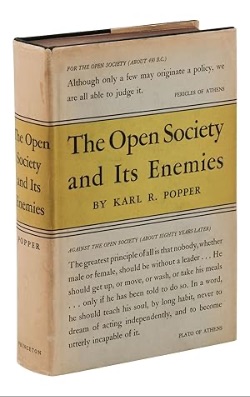
Karl Popper worried about the day a Donald Trump would walk onto the stage. He had watched democracies erode from within—fear rising, dissent narrowing, leaders claiming special authority in moments of crisis—and he asked a simple question: how do free societies keep the ability to correct power before it hardens?
The Open Society and Its Enemies, written during World War II, reads less like history and more like a field manual. Popper argued that the greatest danger is not only force, but the belief that force is necessary and inevitable. When leaders claim to act on behalf of History, security, or destiny, they ask citizens to suspend doubt. That is how open societies begin to close.
His distinction is clear. Closed societies rely on fixed truths, unquestioned authority, and the idea that some people are entitled to rule. Open societies accept something more fragile: that knowledge is fallible, power must be constrained, and no leader is beyond criticism. Their strength is not unity, but corrigibility—the ability to notice mistakes and change course.
Popper rejected both fatalism and the search for better strongmen. The work is not to find the right ruler, but to limit the damage any ruler can do. He warned against “historicism”—the idea that history follows iron laws. Once you believe that collapse is inevitable or that one side is destined to win, responsibility disappears. The future becomes something that happens to us.
Against this, Popper insisted: the future is open. There are no guarantees of collapse or redemption. There are only choices.
In practical terms, that means refusing the story that “this is inevitable.” It means strengthening guardrails rather than romanticizing leaders: defending checks on executive power, reinforcing independent courts and free media, and pushing back against corruption and concentrated wealth. It means being firmly intolerant of intolerance—drawing clear lines against political violence, lies, and attacks on basic rights.
It also means acting where you actually have leverage. Popper’s politics are piecemeal: fix specific problems in real institutions. Join or support organizations that defend civil liberties. Show up in local government. Back professional norms that resist corruption. Protect spaces—libraries, classrooms, congregations—where honest disagreement is still possible.
An open society survives this way: through habits. Through people who refuse both cynicism and certainty. Who treat optimism not as a mood, but as a discipline—acting as if what they do helps determine the outcome.
For the many who are asking how we personally respond to a democracy that feels increasingly captured by wealth and power, Popper’s answer is not to wait for rescue. It is to constrain power, defend open institutions, and keep acting as if the future is still genuinely open—because it is.
BOOK: The Open Society and Its Enemies