June 21, 2024
Habitat
“The car is not only a monstrous land-eater itself: it abets that other insatiable land-eater—endless, strung-out suburbanization.”
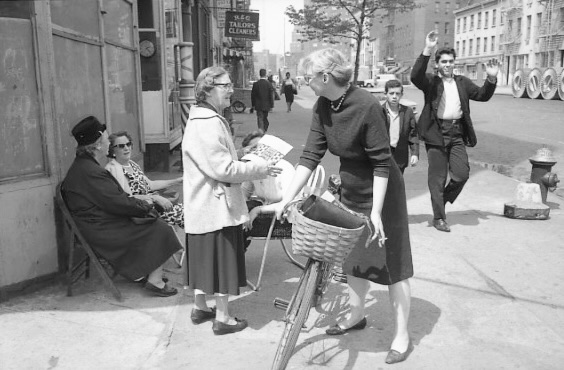
Portraits of Jane Jacobs from the early 1960s show her cycling around her West Village neighborhood. Her husband Jim Jacobs recalled their groceries being delivered by cargo bike every Saturday afternoon.
Portraits of Jane Jacobs from the early 1960s show her cycling around her West Village neighborhood. Her husband Jim Jacobs recalled their groceries being delivered by cargo bike every Saturday afternoon.
Portraits of Jane Jacobs from the early 1960s show her cycling around her West Village neighborhood. Her husband Jim Jacobs recalled their groceries being delivered by cargo bike every Saturday afternoon.
"In the 1950s, in the glory days of the American automobile industry, when Jane and Bob Jacobs moved to Greenwich Village and their contemporaries were acquiring tail-fined cars and moving to the suburbs, she went to work and got around Manhattan by bike. Cycling was a daily activity. Although she could take the subway, Jane regularly rode to work at Rockefeller Center for her job at the Time Incorporated magazine Architectural Forum, parking her bike in the Rockefeller Center garage. Cycling was then still common in Greenwich Village and other parts of New York, and Jim Jacobs recalled their groceries being delivered by cargo bike every Saturday afternoon. Portraits of Jane from the early 1960s show her cycling around the West Village to promote West Village Houses, an affordable housing development that she spearheaded and helped design, which was finally completed in 1975. But in her last book, Dark Age Ahead (2004), published when she was 88, Jacobs reflected on car-dependency as a serious impediment to a sustainable society. 'In cities that underwent urban renewal in the 1950s and later and in new suburbs, stores and working places were segregated from residences, without feasible, much less enjoyable, walking or bicycling routes,' she wrote. 'By the mid-1960s, simply to get to a job, or to find a job in the first place, or to buy provisions, or to get a child to school or a playground or a playmate, a car became a necessity.'” - Peter L. Laurence
ARTICLE: Jane Jacobs, Cyclist