June 26, 2026
Civics
The way we come together matters.

Jürgen Habesmas, at the Europápont, 2014. Photo: European Commission/ Szabolcs Dudás
Earlier this month Alex Ross wrote a lucid, unsettling portrait of the stubbornly hopeful Jürgen Habermas, a philosopher who spent much of his life asking how human beings might learn to govern themselves together. I had to read “Jürgen Habermas Defended Reason in a Darkening Age” twice: once because it is deliciously dense with philosophy and intellectual history, and again because I kept recognizing themes that have long shaped my own thinking.
Habermas spent nearly a century trying to protect and repair democracy with nothing more glamorous than conversation, the kind that takes time and leaves the participant a little changed. He believed that what saves us is not a strongman or a perfect system, but our ability to learn, deliberate, and act together in public.
This is why the essay felt so familiar. It gave language to an idea that sits near the center of Love & Work: that the way we come together matters.
Habermas is best known for his concept of the “public sphere,” the shared space where public opinion is formed. In his early work he traced how, in eighteenth‑ and nineteenth‑century Europe, coffee houses, reading societies, salons, and civic associations allowed private individuals to “come together as a public” and debate matters of common concern, rather than leaving those questions solely to rulers or markets. For him, these were not historical curiosities; they were the infrastructure that made modern democracy imaginable in the first place.
Building on that, we can think of the public sphere as any realm of social life where people can meet more or less as equals, have open access to one another, and argue about how we want to live together, without being directly scripted by the state, the market, or a party machine. In our time, that might look like a neighborhood library, a community garden, a union hall, a reading group, or a long‑running email or group‑chat thread that becomes a real site of shared thinking. It might even be, in a modest but real way, a catalog like this one, if we use it as a common table where we bring ideas, test them against experience, and let them shape what we do next.
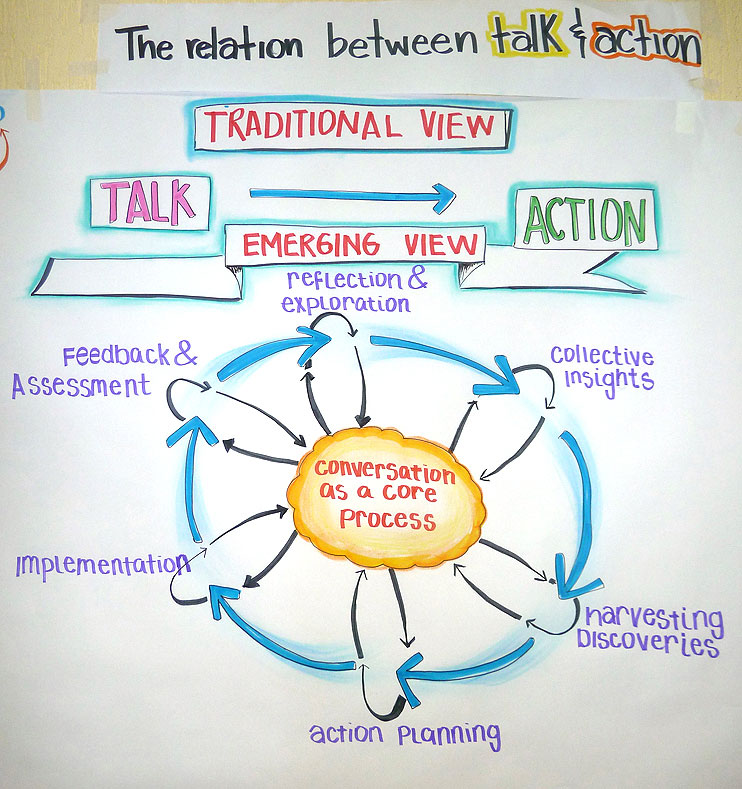
His second major idea, communicative action, is what happens when conversation becomes a tool for understanding rather than winning. It is the difference between trying to score points and trying to make sense of reality together. It requires people to say what they mean, hear what others mean, and allow the exchange to influence what happens next.
That kind of conversation is slow. It is often frustrating. It is also the foundation of any functioning democracy.
Ross reminds us that Habermas held onto this belief even as the world increasingly chose shortcuts: propaganda, technocratic management, winner-take-all politics, and the outrage engines of social media. Reading the essay today, it is easy to conclude that he lost.
Yet it is equally possible that he spent his life describing the only path that ultimately works.
This is where another aspect of his thinking becomes important. Habermas was not a revolutionary in the classic sense. He did not believe in burning everything down. He believed in improving institutions, laws, and habits of civic life one step at a time.
Small steps. Big direction. Slow radicalism. That idea should feel familiar to regular readers. Love & Work is a bet on the same strategy. We do not have a lever capable of transforming national politics. What we do have is a growing collection of stories, examples, practices, and experiments that help people imagine and build better ways of living together.
When we explore libraries as civic anchors, worker cooperatives, co-housing communities, regenerative farms, participatory schools, restorative justice, or democratic innovations, we are not studying isolated projects. We are studying different ways people are learning to cooperate.
The language varies. Mutual aid. Civic imagination. Popular education. Community wealth building. People’s assemblies. Regenerative design. But the gestures rhyme like great hip-hop lyrics.
Across different places and disciplines, people keep rediscovering the same lesson: the way we come together matters. The quality of our relationships shapes the quality of our institutions. The quality of our institutions shapes the quality of our lives.
This is one reason I curate Love & Work the way I do. The goal is not merely to collect good ideas. It is to help us become more skillful participants in the shared work of building cultures, communities, and institutions worth belonging to.
Ross’s essay leaves us with a hard truth. Habermas did not live to see his vision realized. But that does not make the vision wrong. It makes it unfinished.
Perhaps that is what I found so unsettling about Ross’s portrait. Habermas leaves us nowhere to hide. If democracy depends on our ability to think together, then there is no substitute waiting in the wings. No technology, ideology, institution, or charismatic leader can do the work for us. The work belongs to all of us.
A winner-takes-all game can never be won. Sooner or later, the costs become unbearable. The overreach, the exhaustion, and the damage accumulate until cooperation is no longer optional. It becomes practical.
When that moment arrives, we will need more than policies and platforms. We will need places where people know how to think together, learn together, and act together.
The task, then, is not to save democracy all at once. The task is to tend the rooms we share. To create spaces where honest conversation is still possible. To strengthen the habits that allow people to disagree without becoming enemies. To keep practicing the difficult art of deciding what comes next together.
That is what this catalog is for. That is who “we” are becoming.
ARTICLE: Jürgen Habermas’s Unfinished Project