May 1, 2026
Economics
Economies built on mutuality can reshape the rules of the system itself.
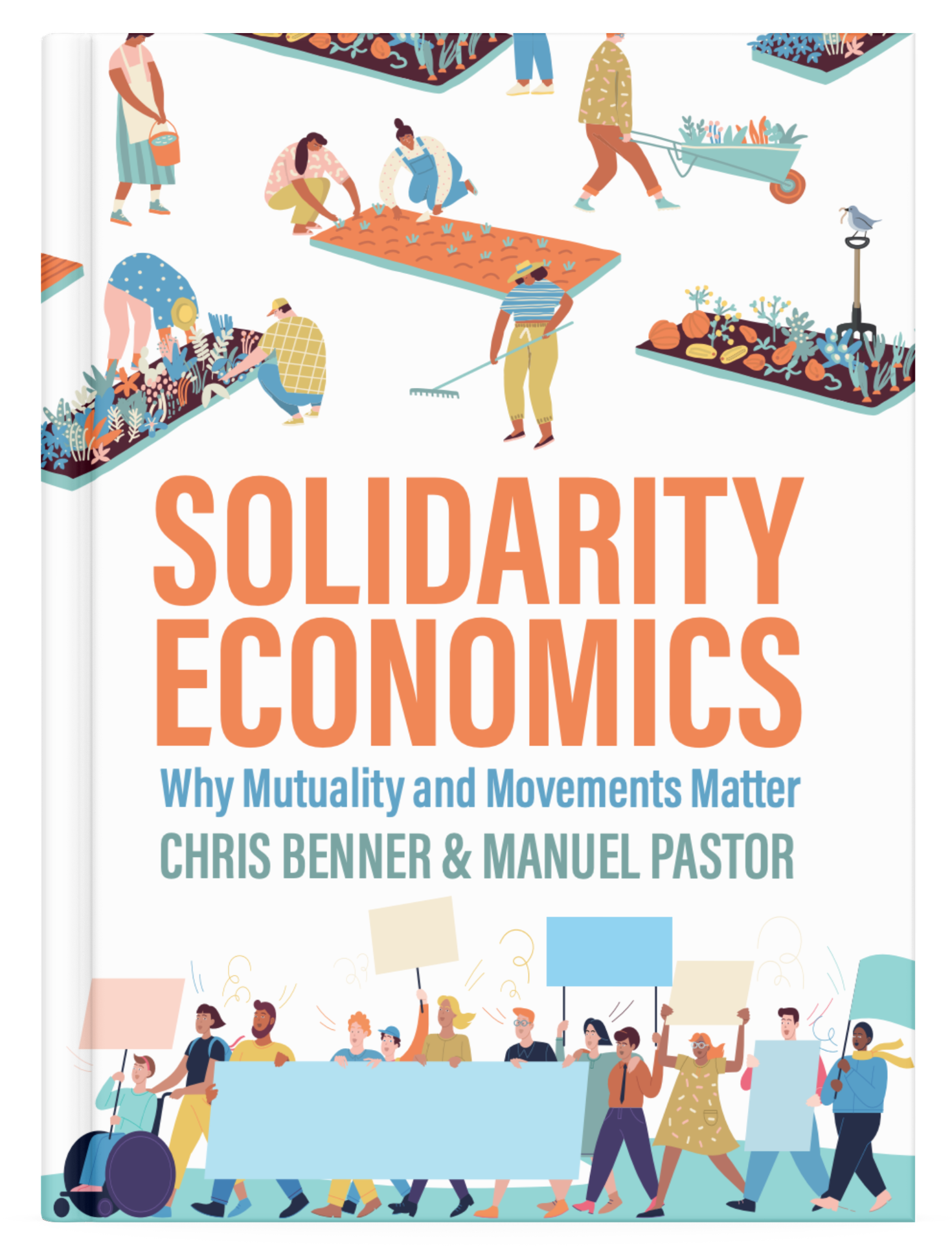
When I was young, the “economy” showed up at the end of the evening news, right next to the weather—“Today the Dow closed…”. It never occurred to me that the economy belonged to all of us—or that my choices had any bearing on how it worked. But then in the early 70s I started to experiment with new ways of exchanging goods and services. We bought our vegetables from a food co-op, we organized a buying group to save money on groceries, we started a business that we passed on to its workers at cost. But how these small steps actually changed the capital E Economy remained a mystery.
In Solidarity Economics: Why Mutuality and Movements Matter, economists Chris Benner and Manuel Pastor show how those kinds of small, local experiments connect to something much larger. Their central claim is straightforward: economies built on mutuality—cooperation, shared ownership, and reciprocity—combined with organized social movements can reshape the rules of the system itself, producing outcomes that are more equitable, more stable, and more democratic.
Their core claim is both empirical and normative: our economy already depends on mutuality far more than conventional economics admits. Innovative industries, public infrastructure, functioning supply chains, healthy communities—none of it works through competition alone. It works through collaboration, trust, and shared investment. The problem is not that we lack solidarity. It is that our institutions are not designed to recognize, protect, or extend it.
From that foundation, the book maps three interlocking horizons of change:
What can be practiced now. Worker-owned businesses, credit unions, community land trusts, mutual aid networks, anchor institution procurement—these are not experiments waiting for permission. They are already operating, already demonstrating that ownership and governance organized around shared obligation produce different outcomes. These are the on-ramps: places where anyone can begin to shift their economic life.
What is being demonstrated at regional scale. Emilia-Romagna’s globally competitive cooperative manufacturing network, the Mondragon corporation’s 80,000-person cooperative enterprise, the Cleveland Model’s use of hospital and university purchasing to reshape local supply chains—these show that solidarity economics is not confined to small, local efforts. The principles scale. But they scale through decades of institution-building, civic trust, and deliberate policy—not overnight.
What requires foundational change. At the level of global supply chains, pharmaceutical R&D, and heavy industry, the authors are clear about what remains unresolved. Full application at that scale will require shifts in intellectual property frameworks, open-source research infrastructure, public investment in frontier science, international labor and environmental standards, and much stronger state capacity than most governments currently choose to build. Importantly, these are not reasons to dismiss the framework. They define the longer arc of the work—the structural ground that today’s practices begin to prepare.
What Benner and Pastor offer, then, is not a finished system but a reorientation: away from “Can this replace everything that exists?” and toward “In what direction are we building, and whose well-being does that direction serve?” That shift is the point. It turns the economy from something we analyze at a distance into something we participate in shaping—step by step, and together.
BOOK: Solidarity Economics: Why Mutuality and Movements Matter