November 28, 2025
Economics
How can we learn from Indigenous wisdom and ecological systems to reimagine currencies of exchange?
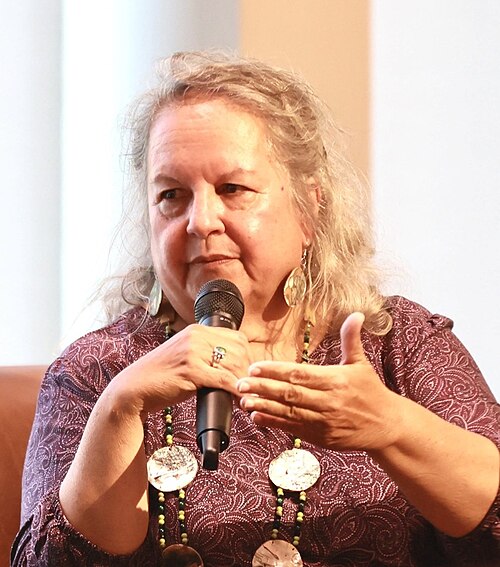
Robin Wall Kimmerer is a MacArthur Fellow and was awarded the National Humanities Medal. She lives in Syracuse, New York, where she serves as a SUNY Distinguished Teaching Professor of Environmental Biology and is the founder and director of the Center for Native Peoples and the Environment.
This week my friend and colleague Beth Tener wondered aloud how a country as wealthy as ours can leave so many people without the stability and opportunity our prosperity should make possible. She pointed us to Robin Wall Kimmerer’s reimagining of how we exchange value.
In this essay, Kimmerer—a mother, scientist, professor, and enrolled member of the Citizen Potawatomi Nation—reflects on the native fruit the serviceberry and its role in the ecosystem. It offers its fruit freely, showing us that nature’s abundance is a gift, not a commodity. Birds, insects, and people benefit from the fruit, and in return, pollinators and seed dispersers help the plant thrive.
Kimmerer urges us to rethink our systems of exchange by learning from the serviceberry and from Indigenous gift economies, models built on gratitude, reciprocity, and shared flourishing. She imagines an economy rooted in relationship rather than transaction, where cooperation, sharing, and cyclical resource flows replace competition and accumulation.
In Potawatomi, the words for “berry” and “gift” are linked, highlighting the spiritual and relational meaning of abundance. Gift relationships create social capital, goodwill, and resilience. The value lies in the relationship itself; gifts sustain future reciprocity and support.
On this Thanksgiving holiday, it’s nice to imagine what an economy of mutual flourishing could look like.
"Gratitude is so much more than a polite 'thank you.' It is the thread that connects us in a deep relationship, simultaneously physical and spiritual, as our bodies are fed and spirits nourished by the sense of belonging, which is the most vital of foods. Gratitude creates a sense of abundance, the knowing that you have what you need. In that climate of sufficiency, our hunger for more abates and we take only what we need, in respect for the generosity of the giver."
"The words 'ecology' and 'economy' come from the same root, the Greek oikos, meaning 'home' or 'household': i.e., the systems of relationship, the goods and services that keep us alive. The system of market economies that we’re given as a default is hardly the only model out there. Anthropologists have observed and shared multiple cultural frameworks colored by very different worldviews on 'how we provide for ourselves,' including gift economies."
ARTICLE: The Serviceberry. An Economy of Abundance