January 9, 2026
Civics
Care, dignity, and belonging as the core antidotes to resentment politics
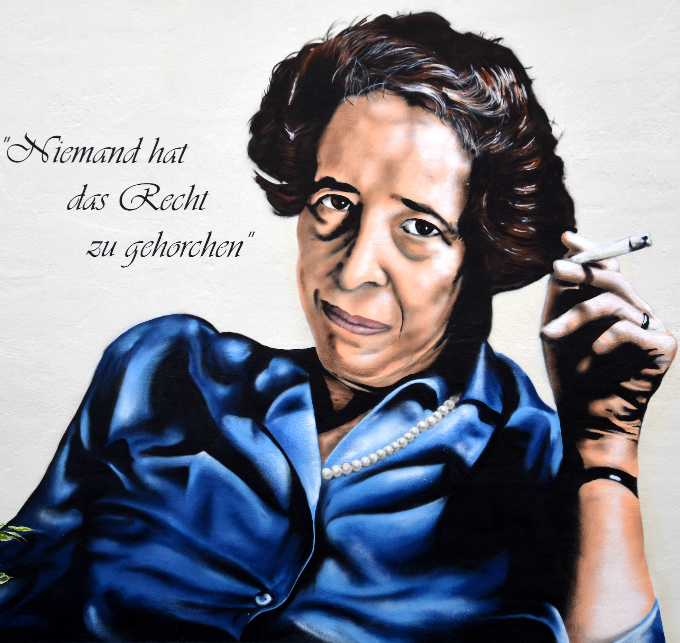
Translation: "Nobody has the right to obey." Portrait of Hannah Arendt by graffiti artists Patrik Wolters and Kevin Lasner, painted on a wall in the courtyard of her birthplace in Hannover, Germany.
By invading Venezuela in defiance of both national and international law, Trump is fulfilling a campaign promise. He has been explicit about his intention to pursue an imperial mindset. In her efforts to trace the roots of Nazism and Stalinism, Hannah Arendt described this posture as “the limitless pursuit of power after power.” She was referring to European imperialism, particularly the British Empire, as it evolved into a politics of boundless expansion.
Christopher Finlay, Professor in Political Theory at Durham University, has written a timely article about how Arendt can help us understand this new age of far-right populism. In her book The Origins of Totalitarianism Arendt described how totalitarian regimes are not content with stability; they remain in constant motion, rewriting reality so that facts are brutalized into line with propaganda. Their intention is to produce subjects who no longer distinguish truth from falsehood—an extreme version of today’s “post‑truth politics.”
He suggests that perhaps the Arendt's most important lesson is to resist explaining these unprecedented political formations purely through old clichés such as generic nationalism or simple economic grievance. She pleaded that over‑using the label “totalitarian” for phenomena like Trumpian populism can be either alarmist or falsely reassuring. She called instead for a “meditated, attentive facing” of reality as it is, trying to grasp emerging threats to democracy on their own terms before they fully crystallize.
Finlay observes that the mediated, attentive facing reality we have today is that Trump appeals to socially isolated and economically “left‑behind” people in de‑industrialized regions. He recognizes that they feel that their real concerns are ignored and are therefore vulnerable to conspiracy theories and strongmen.
Recalling again Martin Luther King Jr.'s maxim that only love can fight hate, it seems to me that meeting left‑behind people where they are, naming manipulative strategies (including Trumpism), and trying to ground political work in something like care, dignity, and belonging might be the most effective way to counter Trump's audacious actions. In fact, groups like Down Home North Carolina and other deep‑canvassing and bridging efforts are already practicing this kind of work, building trust with rural and working‑class neighbors through slow, empathic conversations that center shared needs and mutual care.
These efforts are organized around care, dignity, and belonging as the core antidotes to resentment politics: listening first, validating pain, and then gently unpacking how Trump's strategies weaponize that pain. These rural organizing, deep canvassing, and democracy‑truth efforts matter.
ARTICLE: How Hannah Arendt Can Help Us Understand This New Age of Far-Right Populism