December 19, 2025
Learning
"With so much awful shit going on around us, how dare we deny the profound beauty of engaged experience when it is offered to us?"
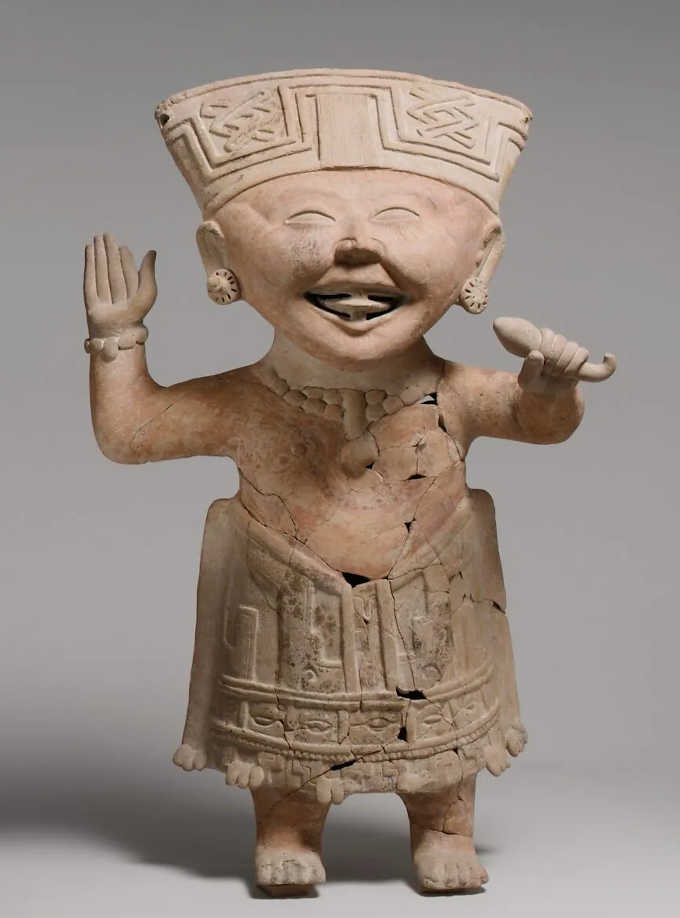
Smiling Figure, South central Veracruz, 600-1000 CE
Douglas Rushkoff’s work often critiques corporatism, financialization, and the “anti-human” logics of digital platforms, while calling for more cooperative, community-centered systems. He is acutely aware that millions of Americans face deepening poverty, that roughly 18 million households experience food insecurity, and that climate change, topsoil erosion, the displacement of Indigenous peoples, industrial encroachment on rainforests and wetlands, and the spread of microplastics and “forever chemicals” define our moment.
In this article, however, he deliberately steps back to name something that coexists with these crises: many of us still encounter moments of genuine joy, awe, and embodied bliss. He argues that such joy, especially in dark times, functions like nourishment in a damaged ecosystem. Those of us living in “warm spots” of relative safety and beauty, he suggests, have a responsibility to fully embrace that goodness on behalf of the whole, rather than suppressing the experience out of a sense of guilt.
Moments of grace—snow, sunsets, friendship, art—are not distractions from suffering but gifts that open the heart and deepen our capacity to perceive it. Rushkoff describes these experiences as practices that have the ability to transform anguish into energy, much like a New Orleans funeral band shifting from dirge to jubilant song.
I was reminded of his counsel yesterday as Debbie and I walked in the woods in the late afternoon. Even as we remarked how early the day was already closing—around 4 p.m.—we were both stopped by the setting sun kissing the sky with a luminous wash of purple and umber. Finding and inhabiting such pockets of joy amid catastrophe is not indulgence but duty: a way of reconnecting to the world, processing collective trauma, and using one’s own gratitude as a compass for right action.
"It’s not like we’re oblivious. Few of us are in danger of aspiring to a…let’s call it a 'Mar Lago lifestyle,' where one’s joy is predicated on maintaining the walls of separation between themselves and those they exploit. Smoking cigars with fellow elites and celebrating the very separation they’ve been able to create between their own experience and everyone else’s. Victory or domination over some ‘other,’ whose defeat or inferior position is one’s only measure of success.
"No, the joy I’m talking about is the very opposite. Not the joy of triumph or domination, but the joy of feeling connected to everyone and everything else. Not the joy of winning the soccer game, but of operating in wordless harmony with the other members of your team. That collective or at least connected bliss/flow state. It’s not at the expense of others. It requires the others."
ARTICLE: Is it Okay to Feel Good in the Midst of Chaos?