December 12, 2025
Communication
Stories help people understand that the futures we picture together can become the futures we build.
Within reparations work, the term “hope gap” describes the disconnect between support and belief. Many people back an issue, yet far fewer think meaningful change can realistically happen in their lifetime, especially around Black reparations and Indigenous Land Back. For the BLIS Collective, the “hope gap” is the distance between strong support for reparative policies and the much weaker belief that those policies are actually achievable.
BLIS argues that this gap is a core narrative challenge of our time. When people doubt that change is possible, they disengage or lower their expectations, even when their values strongly favor repair. Closing the hope gap requires braided narratives, visible wins, and stories of solidarity that help people see bold reparative policies as both desirable and attainable.
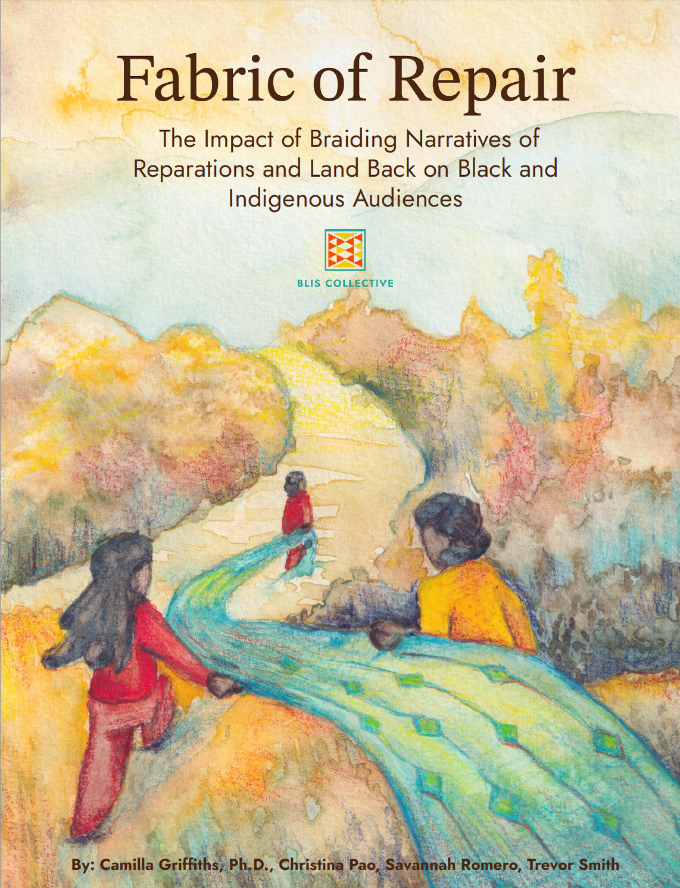
The group recently completed a major narrative research project examining how stories about Black reparations and Indigenous Land Back can strengthen solidarity across both communities. Titled Fabric of Repair: The Impact of Braiding Narratives of Reparations and Land Back on Black and Indigenous Audiences, the study uses surveys and experiments with more than 4,500 Black and Indigenous participants to test different narrative frames. It compares three approaches: a reparations-focused story, a Land Back–focused story, and a “braided” narrative that links both histories and reparative solutions.
BLIS frames the “fabric of repair” as a future grounded in Indigenous sovereignty, Black liberation, and collective healing—where addressing historic harms becomes the basis for a stronger, more just social fabric. The project serves as both research and an organizing tool, providing narratives, data, and resources that movements can use to build narrative power, close the hope gap, and deepen Black–Indigenous solidarity.
"The Hope Gap is the defining narrative challenge of our time: Despite 76 percent of Black respondents supporting reparations, only 21.5 percent believe it's possible, and despite 80 percent of Indigenous respondents supporting Land Back, only 19.1 percent think it's possible. The gap between support and belief is where our movements lose momentum -- and where our narrative interventions must focus in this moment."
RESEARCH REPORT: Fabric of Repair
ARTICLE: New Research on Solidarity Narratives and Reparations