March 28, 2025
Learning
'Have we become apathetic about the possibility of things ever being radically different?'
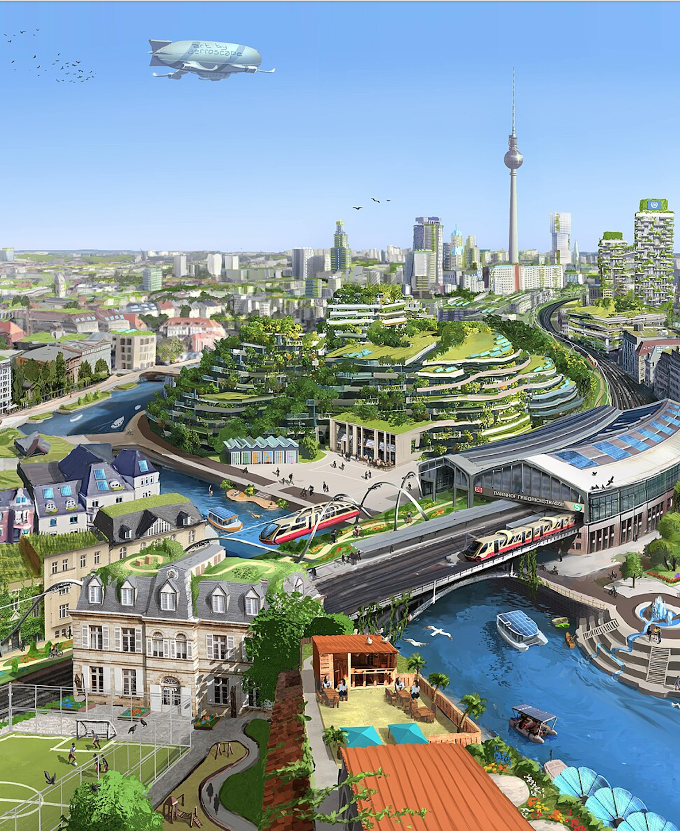
An aerial view of a futuristic, sustainable Berlin - with lots of solar power, trees and greenery, airships, walkable streets, clean water... Aerroscape & Lino Zeddies via CC
An aerial view of a futuristic, sustainable Berlin - with lots of solar power, trees and greenery, airships, walkable streets, clean water... Aerroscape & Lino Zeddies via CC
In modern discourse, "utopian" is often used as a criticism, equated with unrealistic or impossible ideals. Caitlin Rajan presents a well-reasoned argument that on the contrary utopian thinking plays a critical role in problem solving.
She notes that utopian thinking challenges the assumption that social structures are rigid, highlighting instead their flexibility. It cultivates essential political skills, including critical analysis, holistic reasoning, and creative problem-solving. Most importantly, it injects hope and imagination into political discussions.
Notably, utopianism is not about achieving a flawless society. Rather, it serves as a framework for envisioning and striving toward a better future. This perspective encourages a more practical, adaptable approach to societal progress, emphasizing the process rather than an unattainable perfection.
"Childcare and free education – now part of everyday reality – were once flights of utopianism. Thus...the idea that utopian imagination necessarily precludes a grounded politics is false. Utopian thinking is not wishful thinking but, grounded in the realities of the present, it simply allows creativity and imagination to enter discussions about the status quo and its flexibility."
"Utopian thinking shows itself as a form of ‘radical hope’ that trusts in the possibility of a better future, even if it’s not something we can yet envision or understand. Utopianism, then, is a sort of resistance to a politics that makes the possibility of transformation appear closed off."
ARTICLE: We Need The Toolkit Of Utopian Thinking, Now More Than Ever.