June 12, 2026
Everything is connected and the connections are alive.
We’re trained to think in categories, trust experts, and solve problems one piece at a time.
A kid struggles in school—call in education.
A river gets polluted—call in environmental policy.
A community fractures—call in the politicians.
Rising anxiety and loneliness—hand it to mental health.
This division of labor is efficient if your definition of efficiency is solving isolated problems. But the challenges that define our time are not isolated at all. Such a simplistic view seriously distorts what is actually happening.
The reality is that the world doesn’t arrive in labeled boxes. It shows up as a mesh of relationships.
A child’s well-being isn’t just about school; it’s about family, food, housing, safety, the stories they’re breathing in, and whether the surrounding community is holding together or coming apart. A community’s health depends on its economy, culture, ecosystems, governance, and sense of meaning—all at once. Tug on any one thread and you start to feel the whole fabric move.
For a long time, we’ve been fond of the machine metaphor: discrete parts, clear functions, find what’s broken and swap it out. But what we’re actually dealing with are living systems. Relationships matter more than components. Feedback matters more than control. Context changes everything. A tweak in one corner can ripple outward in ways no blueprint anticipated.
Ecological imbalance, political polarization, loneliness, inequality, declining trust, and stressed school budgets are often symptoms of the same underlying patterns. Disconnection from nature, extractive rather than regenerative economic practices, concentrated power, and short term horizons fray the relationships between people and the places and beings they depend on. They manifest in inadequate housing, fragile supply chains, clear-cut forests, and in tendencies to reach for a glowing screen when we are scared, bored, or exhausted.
We live in a time when it is easier than ever to connect in the thinnest sense—likes, follows, scrolls—while genuine mutuality and shared fate can feel far away. We can hide behind devices, brands, and roles and still feel exposed and alone. The culture keeps pushing us toward fragments; our bodies keep registering that something about this does not add up.
The good news is that the same dynamic works in the other direction.
When systems become healthier, improvements tend to travel together. Strengthen community ties and you often see gains in public health, local economies, and civic participation. Restore ecosystems and human well-being tends to follow. Open up institutions and you frequently get both more trust and more innovation. Shorten supply chains and suddenly you’re talking about resilience, local identity, and climate all at once.
Problems cluster. Solutions do too. That’s the backdrop for the work gathered in Love & Work.
Individually, the projects can look modest. Local, specific, even niche: a community land trust here, a regenerative farm there, a reimagined school, a worker-owned business, a neighborhood commons, a new approach to public budgeting, a collective kitchen, a different way of handling conflict in a council meeting.
Taken one at a time, they address something immediately in front of them: housing insecurity, soil depletion, youth disengagement, precarious work, or frayed public life. Taken together, they begin to reveal a pattern.
Across different places and sectors, people keep rediscovering similar moves: strengthen relationships, build capacity instead of dependence, distribute power, design with living systems rather than exploit them, slow down enough to listen to the land and to one another. The language varies—solidarity economy, mutual aid, regenerative design, popular education, trauma-informed care—but the gestures rhyme.
Systems thinking, in this context, is about improving your ability to notice connections, especially the ones that are not obvious at first glance. It’s about training your perception so that when something hurts—a child, a river, a democracy—you can feel for the pattern around it, not just the symptom in front of you.
That shift changes the questions you ask. Instead of “How do we fix this problem?” you start asking, “What pattern is producing this—and what pattern would produce something better?” Instead of “Who’s to blame?” you begin to wonder, “What relationships are missing here? What feedback loops are out of balance? What would happen if we rewove this piece of the web rather than simply tightening the bolts?”
That doesn’t make the work simpler. If anything, it makes it more demanding. You are asked to hold more variables, more histories, and more perspectives. You are asked to notice how your own habits and identities plug into the pattern.
But it does make the work more coherent. What first looked like a scatter of unrelated efforts begins to resolve into something like a shared project spread across disciplines, geographies, and communities. People working on housing, education, ecology, democracy, health, and local economies may not use the same vocabulary, but they are often moving in the same direction: away from isolation and extraction, toward connection and reciprocity.
Seen in that light, what you are witnessing is not merely problem-solving. It may be an early-stage redesign of how we live—how we relate to one another, to our institutions, and to the wider web of life. It is tentative, partial, and full of contradictions. It is also real. And it becomes more visible the more you practice noticing.
The map that follows will not be complete. No map is. It will have gaps and blind spots, and you may see connections we have missed. Good. That is how the map improves. In this emerging world, everyone is both a learner and a teacher.
About the photo
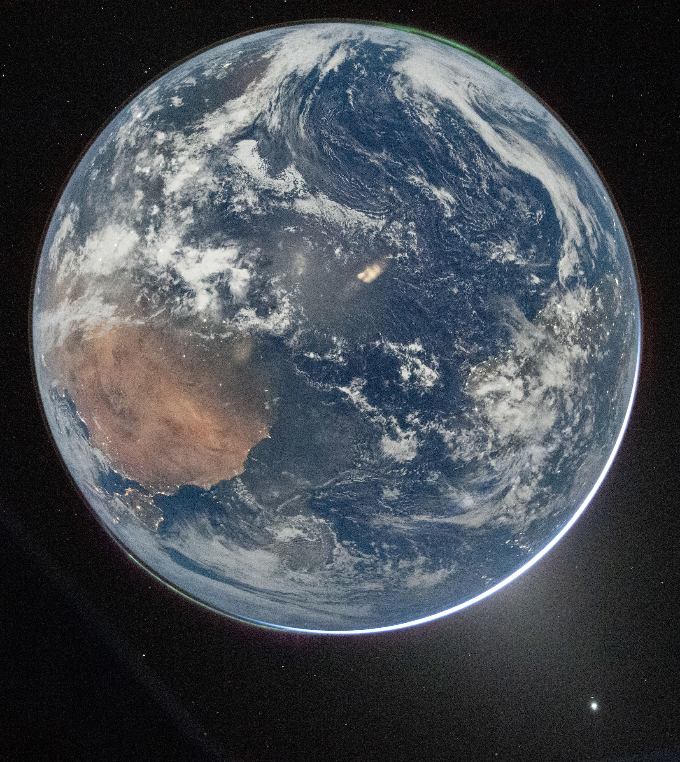
Reid Wiseman, NASA astronaut and Artemis II commander, took this photograph of Earth from the Orion spacecraft on April 2, 2026. The Atlantic Ocean dominates the image; the western Sahara and Iberian Peninsula appear on one side of the disk, and eastern South America on the other. Zodiacal light—sunlight scattered by dust in the inner solar system—forms a triangular glow in the lower right as Earth eclipses the Sun.
The image reminds me of something Bill Anders said. Anders, who flew on Apollo 8 and helped capture the famous Earthrise photograph during its orbit of the Moon on December 24, 1968, later reflected: “We came all this way to explore the Moon, and the most important thing is that we discovered the Earth.”