May 29, 2026
I thought I was writing a newsletter filled with things I wanted to read. It turns out I’ve been assembling a field guide to building the world as it could be. A progress report.
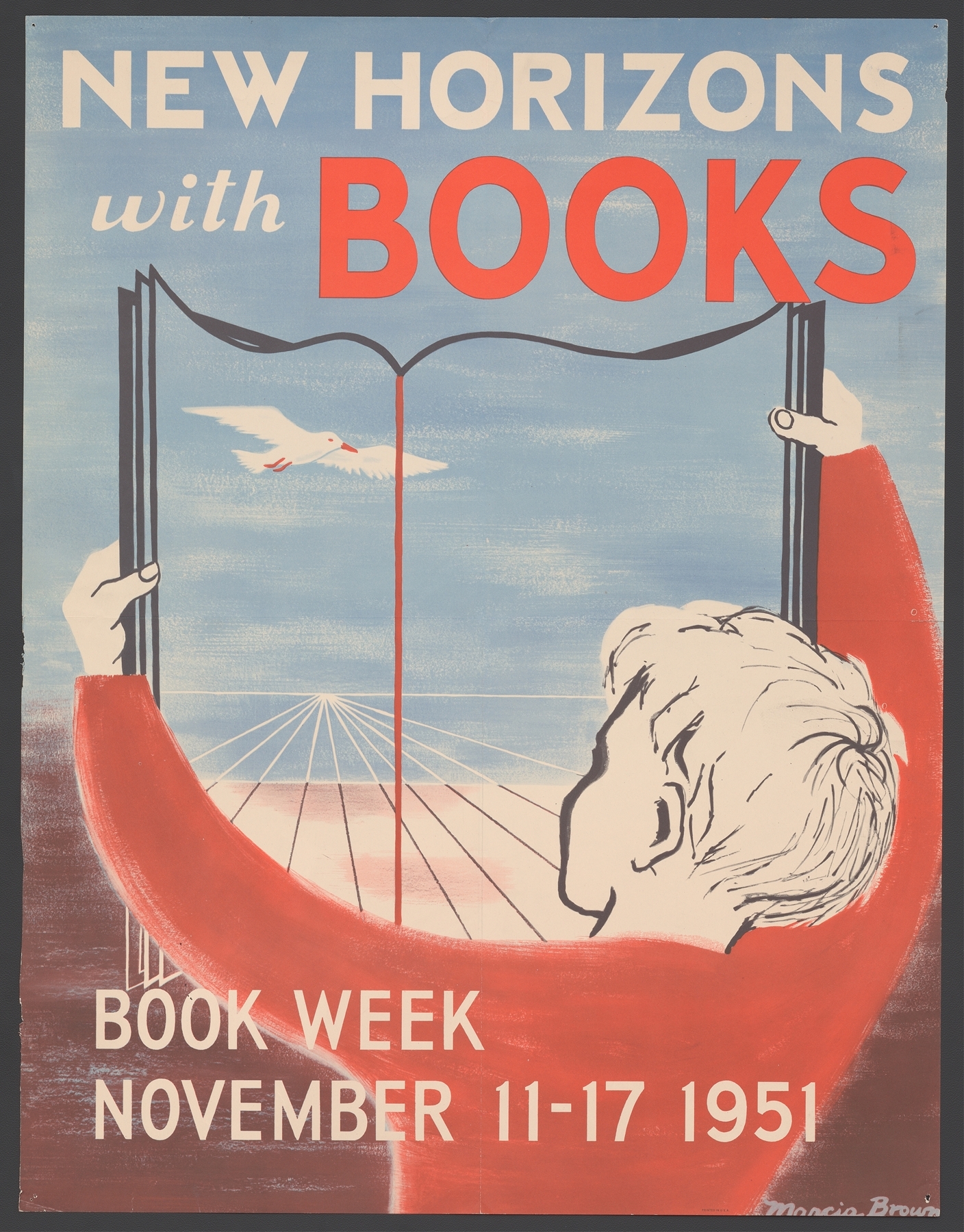
Marcia Brown’s “New Horizons with Books” is a mid-century promotional illustration created in 1951 for National Book Week.
Executive Summary
After ten years of writing the Love & Work newsletter, what began as a modest effort to stay visible as an organizational consultant is evolving into something larger: a comprehensive field guide to building alternative futures.
The core discovery is simple but profound: we already possess much of what we need to build a more humane, democratic, and life-sustaining world. The social technologies exist—systems thinking, regenerative design, dialogue practices, emotional intelligence. The experiments are underway, often quietly, producing outcomes that contradict dominant assumptions about how things must work. What we lack is not technology or evidence, but imagination—the capacity to recognize that things could be different, and the perspective to see how isolated experiments form a coherent pattern.
The Love & Work Catalog is being built to make that pattern visible. It is organized as a field guide across nine zones of practice—Nature, Learning, Teaching, Civics, Economics, Company, Habitat, Communication, and Culture—each representing a territory where transformative work is already happening.
The animating conviction is that these nine territories are not separate domains but expressions of a shared underlying logic about how life-supporting systems work. An insight from regenerative agriculture illuminates classroom design. Cooperative economics rhymes with neighborhood structure. Dialogue practice mirrors the gift economy.
This is cathedral-scale work, being built incrementally and in public, one week at a time. The catalog today is a rough sketch—hundreds of curated articles waiting to be replanted in ways that make their relationships visible. The vision is a living map that readers can navigate by curiosity, by need, or by the particular corner of the work they find themselves in.
When I began writing this newsletter in the summer of 2016, I thought of myself primarily as an organizational consultant with a particular fascination for the power of story. I had spent decades helping organizations and individuals find and tell the truth about themselves. That was the frame I brought to the work.
My original intention was fairly modest: to keep the way I think visible to people who already knew me and, ideally, to generate a few right-fit consulting opportunities along the way. I took to heart Austin Kleon’s advice that the best way to make yourself visible is to write something you yourself would want to read.
What I did not expect was how deeply connected my current reading would be to the visions that first captivated me as a young man. In the heady days of the late 1960s and early 1970s, I was one of the starry-eyed idealists who believed that the world we inherited was not fixed, and that we could create new institutions, new economies, and new ways of organizing life together.
Fifty-five years later, I found myself discovering countless people still working to bring those ideas to life. I came to realize that the experiments many of us began as part of the “youth generation” never stopped. They continued persistently, often outside public attention, generating an extraordinary body of insight and lived practice about how to build a more humane, democratic, and life-sustaining world.
Issue by issue, the frame for the letter kept expanding. I would write about a cooperative business model and find myself in conversation with an educational philosopher. I would write about ecological restoration and discover it was saying the same thing as a community organizing principle. The relationships between ideas kept becoming visible—not because I was forcing them, but because they were there, waiting for someone to look at them together.
What once seemed like youthful idealism has a different name for me now: radical hope. Not optimism, and not innocence recovered, but clarity earned—the decision, made with open eyes, to remain oriented toward what is still possible.
What emerged for me is a deep and abiding interest in cataloging the myriad ways people are already building the world as it could be. But a newsletter can’t hold all of that. So last September I launched the Love & Work Catalog. At first, I simply reposted newsletter essays in the order I had written them. I could sense the theme connecting the pieces, but readers couldn’t. My friend Jamie Wolf named the problem perfectly: it felt like an undifferentiated archive rather than a guided experience.
He was right. It was (and still is) missing a central thread—a rudder. And so the real work began in earnest.
I thought I was writing a newsletter filled with things I wanted to read. It turns out I’ve been assembling a field guide to building the world as it could be.
From here, I can finally see what the catalog itself wants to become. Not simply a collection of interesting articles, but a living map of larger patterns.
And the pattern, as I understand it now, is this:
We already possess much of what we need to build a more humane, democratic, and life-sustaining world. The social technologies already exist—the capacity to think in systems, to design with emergence rather than control, to communicate across difference, to facilitate genuine dialogue, to read the emotional field of a group, to hold complexity without collapsing it prematurely. The evidence is abundant. The experiments are well underway, often in places most people have never heard of, and often producing outcomes that contradict the dominant story about how the world supposedly has to work.
What we lack is not technology. It is imagination: the capacity to recognize that things could be different, and the shared vision necessary to make collective action possible. Our inherited assumptions about ownership, control, hierarchy, and “the way things are” prevent us from using much of what we already know. And it is about perspective, the ability to step back far enough to see the picture that emerges when isolated experiments are viewed together.
As Roberto Mangabeira Unger says so eloquently, the deepest obstacle is not simply money, power, or organized resistance. It is our failure to conceive of alternatives. But that failure is not fixed. It is a condition. And conditions can change.
My hope now is to make the Love & Work Catalog a field guide to making that picture real. Which, finally, brings me to the status report I promised.
What the catalog Is becoming
Today I am intentionally building the Love & Work Catalog as a field guide to alternative futures — organized not by topic but by terrain.
It begins with learning to see: the conceptual tools you need before you can navigate — systems thinking, warm data, leverage points, the failure of imagination, the distinction between living systems and machines. These are important guideposts. They define whether a pattern becomes visible to you or remains hidden in plain sight.
As of today the heart of the guide is nine zones of practice, each one a territory where the work of building a more humane, democratic, and life-sustaining world is already underway: Nature, Learning, Teaching, Civics, Economics, Company, Habitat, Communication, and Culture. I say “as of today” very intentionally. The way-finding for this catalog is an emergent discovery.
Right now, all placement is purely chronological. The ideas sit in the order in which I pulled them from my notebooks. But my goal is that, over time, each zone will be organized according to a consistent architecture: what we are looking at, what to notice, what is already emerging, the questions worth carrying, and field notes on the thinkers and practitioners most worth knowing.
The larger goal is not simply to collect interesting ideas, but to map the deeper patterns that the learning and discoveries begin to reveal.
What ties it all together is the conviction that these nine territories are not separate domains but expressions of a shared underlying logic about how life-supporting systems work. My goal is to present the ideas I’m gathering in ways that make their relationships more visible and easier to grasp. When the catalog succeeds, an insight from regenerative agriculture might illuminate something about classroom design; a principle from cooperative economics might rhyme with the structure of a neighborhood; or the practice of dialogue may turn out to be expressing the same underlying logic as the gift economy.
What the catalog is today
I’m a gardener, so gardening metaphors come naturally to me. At this stage, the catalog still feels like a rough sketch on a sheet of drafting paper. But even in this rough sketch form, I’m beginning to see the different zones that might eventually hold these myriad ideas and make the relationships between them more visible and easier to understand.
Over the past year I’ve dug up a few hundred articles from the newsletter and set them aside like plants waiting in their pots. Now comes the slower work: replanting them in ways that make their relationships to one another more obvious, so visitors can find their own paths through the landscape—by curiosity, by need, or by the particular corner of the work they find themselves tending.
It’s a big project. Like a mason working on a cathedral, I’m fairly certain I will never see it finished. So I’m building it the only way a cathedral can be built: one week at a time, in public, with the work visible as it slowly accumulates.
If you’ve found your way here, I hope you’ll come back to watch it rise. And please, tell me what you see that I may be missing. The map is made by walking. And the walking is better with company.
Ten years in, it turns out I’m just getting started. I’m glad to know you’re beside me.
About the illustration
Marcia Brown’s “New Horizons with Books” is a mid-century promotional illustration created in 1951 for National Book Week, one of several overlapping postwar campaigns—alongside Children’s Book Week—designed to encourage literacy, library use, and a lifelong love of reading.
The campaigns used posters, bookmarks, classroom materials, and public events to frame books as portals to possibility. In the years following World War II, illustrators like Brown were commissioned to create imagery that linked reading not simply to education, but to imagination, citizenship, and cultural renewal. Book Weeks of that era often featured library displays, author visits, story hours, and school activities built around themes suggesting that books could open “new horizons,” help cultivate democratic citizenship, and even contribute to peace in the postwar world.
What feels striking now is the scale of civic confidence embedded in the campaign: the assumption that reading mattered not only for individual advancement, but for the health of democracy itself.
ARTICLE: On building a field guide to alternative futures

