January 2, 2026
Culture
We've lost touch with the fact that the payoffs to our most meaningful endeavors unfold over years and generations, not news cycles.
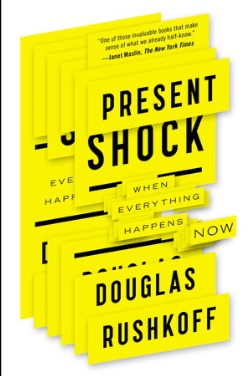
Media theorist, writer, and documentarian, Douglas Rushkoff, published Present Shock: When Everything Happens Now in 2013. More than a decade later, it reads like a field guide to the world we inhabit today. His central theme is that the cultural condition once described as “future shock” has inverted: rather than being overwhelmed by a rapidly approaching future, we are trapped in an always-on, perpetual present. Rushkoff calls this condition “presentism” or “present shock”—a collapse of narrative time in which the long arcs linking past, present, and future lose coherence.
Of particular relevance to my interest in how societies understand themselves, Rushkoff observes that we no longer live within convincing narratives of progress, growth, or shared destiny. Instead, we inhabit a jittery, perpetual now of notifications, crises, and real-time feeds. The “future shock” of too much change has flipped into “present shock”: a temporal flattening that makes it difficult to imagine anything meaningfully different ahead.
He describes this condition as “narrative collapse.” Linear stories with beginnings, middles, and ends lose traction, replaced by endless series, open-ended games, and rolling news cycles that never resolve. This collapse is not merely aesthetic; it is ethical and political, as it erodes the long horizons required for responsibility, sacrifice, and repair.
Present shock makes it difficult to tell stories that extend beyond the next election, product cycle, or news wave. Rushkoff describes people stretched across multiple digital selves and institutions that compress decades of value into quarterly returns. When people cannot locate themselves within a meaningful timeline, he warns, they often gravitate toward end-times fantasies that promise a clean break from feeling overwhelmed.
Rushkoff ultimately recommends boundaries, human-scaled rhythms, and technologies designed around lived time rather than machine time. Given my own bias toward slowness, small-scale experimentation, and everyday civic practice, these prescriptions work for me.
“If you go back and look at the historical record, it turns out that a lot of important ideas have very long incubation periods. I call this the ‘slow hunch.’ We’ve heard a lot recently about hunch and instinct and blink-like sudden moments of clarity, but in fact, a lot of great ideas linger on, sometimes for decades, in the back of people’s minds. They have a feeling that there’s an interesting problem, but they don’t quite have the tools yet to discover them.” Solving the problem means being in the right place at the right time—available to the propitious moment, the kairos. Perhaps counterintuitively, protecting what is left of this flow from the pressing obligation of new choices gives us a leg up on innovation.”
BOOK: Present Shock: When Everything Happens Now