December 26, 2025
Culture
We need a new narrative that can transmit values, orient education, and guide institutions toward sustaining the Earth community.
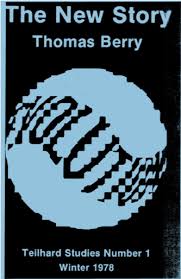
In the late 1970s—at roughly the same time Joseph Campbell was suggesting that our understanding of the universe and our place within it is “all a matter of story”—Thomas Berry, a Catholic priest, cultural historian, and ecological philosopher, was asserting that “we are in between stories.” The New Story: Comments on the Origin, Identification, and Transmission of Values was first published in the winter of 1978, at a moment when environmental crisis and profound shifts in global economics and culture were becoming increasingly visible. In this essay, Berry argued that the old Western religious–mechanistic story of the universe no longer functioned, and that human survival now depended on learning a New Story: a cosmology rooted in evolutionary science that re-situates human values within the unfolding of Earth and the cosmos.
Writing in a style often described as poetic, mythic, slow, and spacious, Berry explained that every civilization lives by an origin story—one that answers where the world came from, who we are, and what counts as real and valuable. Such stories shape emotion, law, education, and the meaning of daily life. He placed the traditional Western “redemption story” (creation–fall–redemption within a static cosmos) in historical context, noting that it once unified societies and “took care of everything.” It offered orientation, purpose, and a framework for ethics and social order, even though it did not eliminate suffering or human folly.
By the time Berry wrote this influential essay, however, that story had lost both credibility and functional power in light of modern scientific and historical awareness. At the same time, the emerging scientific–industrial story—one that framed the universe as a random, meaningless mechanism governed by chance and necessity—offered no adequate grounding for moral or spiritual values, leaving society disoriented.
Berry spoke instead of an emerging New Story, which he called evolutionary cosmology. Modern cosmology and evolutionary biology, he suggested, reveal the universe as an unfolding narrative: from the primordial flaring forth through the formation of galaxies and stars, to Earth’s emergence and the rise of life and consciousness. This “universe story” positions humans not as outsiders to nature, but as a mode through which the universe becomes conscious of itself, inviting a renewed sense of identity and purpose.
For Berry, if humanity is to undertake the essential task of “reinventing the human,” the New Story must become a functional cosmology: a narrative capable of transmitting values, orienting education, and guiding institutions toward sustaining the wider Earth community.
He called for using story to reshape our cultural coding so that human power, technologies, and economies align with the dynamics and limits of Earth’s living systems.
Since then, many analysts have argued that we are living through a deep civilizational crisis—or “polycrisis”—in which the old industrial, extractive, and competitive paradigm is reaching its limits: ecological, social, and psychological. This paradigm is characterized by domination over nature, hyper-individualism, colonial extraction, patriarchy, and growth-at-any-cost economics.
At the same time, an emerging global conversation has begun to take shape around new paradigms for an “ecological civilization” or “great transition,” centered on interdependence, justice, and living within planetary boundaries.
Thomas Berry was a cosmic storyteller of an ecological, sacred universe. We can use his poetic “New Story” of interdependence and Earth community to guide us now.
"It is of utmost importance that the next generation become aware of this larger story here outlined and the numinous, the sacred values that have been present in an expanding sequence over this entire time scale of the world’s existence. Within this context all human affairs, all professions, occupations, and creations of the human have their meaning precisely insofar as they enhance this emerging world of subjective intercommunion within the total range of reality. Within this context the scientific community and the religious community have a common basis. The limitations of redemption rhetoric and scientific rhetoric can both be seen, and a new more integral language of being and value can emerge."
ESSAY: The New Story: Comments on the Origin, Identification, and Transmission of Values